
Skip to content

Guide Articles

How to decide whether to file a human rights complaint (NB)

Summary

  • New Brunswick’s Human Rights Commission handles discrimination complaints; the separate Labour and Employment Board can make a binding decision after referral.
  • The Commission’s intake staff can explain its process and provide forms, but they do not give personal legal advice.
  • Mediation seeks an agreement acceptable to both parties; possible terms include compensation, employment documents, or workplace improvements.
  • Not every complaint reaches a hearing. Consider the evidence, practical support you need, and your own priorities without treating past statistics as a prediction.
Important

This is not legal advice! What you are getting here is just general legal information. It is not a substitute for advice from an actual lawyer about your specific situation. If you need legal advice, we urge you to find a lawyer who can help you.

The New Brunswick Human Rights Commission and what it does

The New Brunswick Human Rights Commission is the agency that deals with discrimination and harassment complaints. One law that protects you from discrimination is the New Brunswick Human Rights Act. Sexual harassment under the act is discrimination based on sex.

The commission receives, mediates, and investigates complaints. If a complaint can’t be resolved, the matter may be referred to a hearing at the Labour and Employment Board, which is completely separate from the commission. The commission is only able to make the decision to either dismiss a complaint or send it to the board. The board has the authority to make a finding of discrimination and award a variety of remedies.

When you think about filing a complaint, you might imagine a process that ends in a definitive ruling that what happened to you was either right or wrong. But in reality, that almost never happens. Complaints are much more likely to be closed at the commission level than referred to the board for a decision; about a quarter of complaints are closed as a result of mediation.

We’re not saying don’t make a complaint to the commission, but it’s very unlikely the outcome will be a public acknowledgement of the fact that you were harassed. If you think you would be satisfied with a private settlement, which could involve such things as money to compensate you for the harm you experienced, an apology or a job reference, then participating in the mediation process could be right for you.

Facts about the New Brunswick Human Rights Commission

  • Every year, 10 to 15 people file a complaint with the commission saying they have been sexually harassed in the workplace.
  • Of the complaints closed by the commission in 2022-23, a quarter were successfully mediated, half were dismissed by the commission director or the commission members, and the remainder were withdrawn, abandoned, or found to be outside the jurisdiction of the commission. 
  • Hardly any complaints to the commission are referred to the Labour and Employment Board: six in each of 2021-22 and 2022-23. 
  • Complaints that are referred to the board for a hearing are seldom sexual harassment cases. 
  • Sources: New Brunswick Human Rights Commission annual reports, CanLII

Why consider filing a complaint with the commission

If you decide to file a complaint with the commission, here are a few things you may get out of the process:

  • It could be a chance to tell the harasser what they did is not okay.
  • You might get back money you lost because of the harassment—maybe you didn’t get a special project or a promotion, or were fired.
  • You might get a reference for a new job.
  • You could request that your workplace make changes that would affect everyone there, not just you, like improving employee policies and training around sexual harassment.
  • It is possible you might get some money to recognize the emotional harm you suffered from the harassment.

How to make a complaint to the commission

The commission suggests that if you are considering making a complaint and want more information to first call or email (506-453-2301; hrc.cpd@gnb.ca). The intake officer you deal with can mail you a complaint kit; otherwise, you can download the forms you need from the commission’s website. The Completing the Human Rights Complaint Form guide contains detailed information about how to fill out the three required forms. See also How to File Human Rights Complaint: New Brunswick.

You can file an application against anybody who is sexually harassing you at work—your employer, a co-worker, a supervisor, a customer, or a contractor. In your application, you can also name the company or organization you were or are working for. Even if your employer is not the one who’s harassing you, they have to protect you from sexual harassment and a harassing environment. See How to report sexual harassment to your employer.

Will the commission accept your application? 

  • You have one year from when the harassment happened to file your application with the tribunal. If the harassment happened more than once, the deadline is one year from the last incident of harassment. 
  • You can file a complaint with the commission if you work in New Brunswick or if the harassment happened in New Brunswick, but not if you work at a federally regulated workplace. See Am I a federally regulated worker? (And why it matters.)
  • You’re covered if you’re unionized or non-unionized, temporary or permanent, an independent contractor, or undocumented.
  • After you file your complaint, the commission might decide that the harassment you faced doesn’t relate to a ground of discrimination under the code. In that case, your application will not proceed. This happens about half the time.

How mediation works

While both you and the respondent—the person your complaint is about—will be encouraged to participate in mediation, no one can be forced to do this. Mediation involves you and the respondent finding a solution to your complaint—something you both agree to. It can happen at any point, including through pre-complaint intervention, before your complaint is formally accepted. 

If you agree to the process, the commission will assign you a mediator. Mediators are experts in dispute resolution and human rights law who listen to you and the respondent and work with both of you to come to a settlement. They’re not supposed to pick a side, and they aren’t supposed to favour either you or the respondent. The purpose of this process is not to determine whether you were sexually harassed according to the Human Rights Act. 

Mediation is usually conducted in person; you and the respondent are in different rooms and the mediator shuttles between the two of you. 

About 25% of complaints are resolved through mediation and more than half of settlements happen at the early stage of the complaint process. But mediation can occur right up to the point where a complaint is referred to the Labour and Employment Board. 

What you might ask for

Money to compensate you for:

  • The harm to your dignity, feelings, and self-respect.
  • Lost wages.
  • The cost of counselling sessions you’ve needed and/or money to cover future counselling.

Besides money:

  • An apology.
  • A reference letter or a letter confirming your employment.
  • A change at the workplace, like including a sexual harassment section in the policies handbook.
  • Your employer having to take a course about preventing and dealing with sexual harassment. 

What are you likely to get?

Details of mediated settlements are private. However, we know that in a number of cases agreements don’t involve money at all; instead, the respondents are ordered to do things like take human rights training or create a human rights policy that all managers would have to be trained about. Where there is a financial settlement for emotional harm, it is usually quite modest: a range of $5,000 to $12,500 is common. There aren’t very many big awards, and they happen when the harassment was particularly bad and went on for a long time. 

For more information

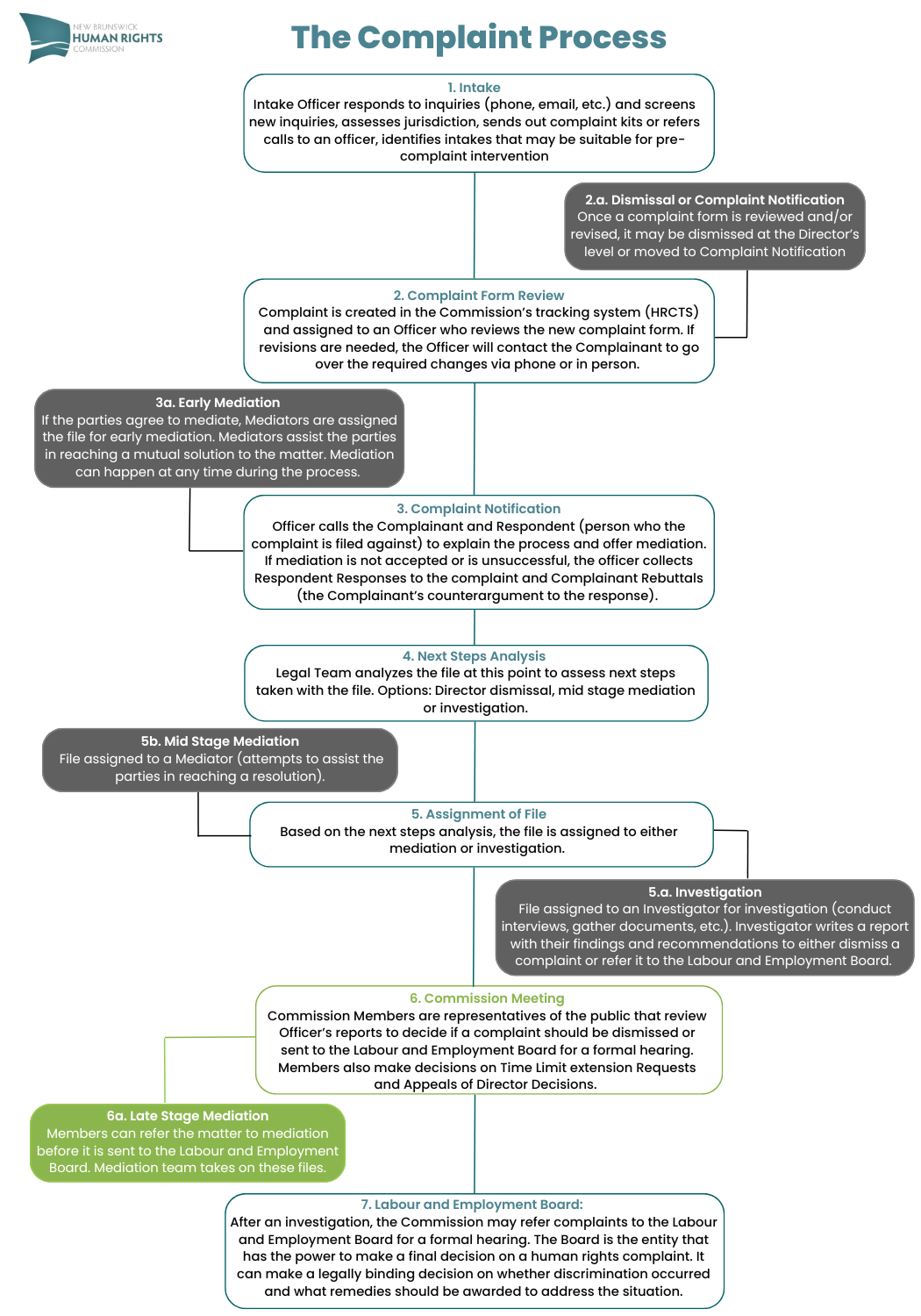
This chart outlines all the steps in the complaint process, including where mediation might occur.

Pros and cons of mediation

Pros

  • The mediation process is free.
  • Many people participate in mediation without a lawyer.
  • You are the one to decide what you will accept from the respondent to make up for the harm they caused.
  • Reaching a settlement is usually faster than a hearing, though the process can take one to two years. 
  • More creativity is possible in mediation. For example, you can’t ask for an apology in a hearing.
  • Everything you say is considered confidential, or “without prejudice”—it can’t be used against you later.
  • There is no risk in participating in mediation. If it fails, the complaint process continues.

Cons

  • Mediation doesn’t give you a chance to publicly say what happened to you or be told that it was wrong.
  • You will likely not get everything you ask for—you have to be ready to compromise.

Beyond mediation

Complaints that aren’t settled through early mediation are analyzed by the commission’s legal team, which may recommend that the complaint be investigated. An investigator gathers information through conducting interviews and reviewing documents, then writes a report recommending either dismissing the complaint or referring it to the Labour and Employment Board for a hearing. 

Pros and cons of your case being decided by the Labour and Employment Board

Pros

  • The Labour and Employment Board has the power to say that, yes, you were harassed, and that what happened to you was wrong.
  • The board of inquiry can order many different remedies. It can award you money. If you were fired or had to quit because of the harassment, it can order your employer to give you your job back. It can order your employer to provide anti-harassment training.

Cons

  • It can take years for a hearing to be held.
  • If you hire a lawyer to represent you, that will be expensive. If you don’t hire a lawyer, your chances of success are much lower.
  • People who represent themselves are less likely to have their complaints found justified.
  • The board usually only awards money for things like lost wages or your expenses as a result of the harassment; it seldom makes awards for harm to your dignity and feelings.
  • Very few people end up being told by a board of inquiry that they were discriminated against and what happened to them was wrong. 
  • If you reach the hearing process stage, you may close the door to other legal options.
  • Even if the board awards you money or other things, that doesn’t mean you will necessarily get them. It can be hard to force your employer or the harasser to give you everything the board ordered, or what you agreed to in mediation.
  • Like in any legal process, your opponents will try to undermine your credibility and make you look bad. You could end up feeling disbelieved and unsupported.
  • Some psychologists believe it’s a bad idea for people who have experienced sexual harassment to get involved in any legal process. They say legal processes can slow down your ability to heal emotionally from what happened to you, because they keep you focused on the past. These experts believe that it can be healthier for the person who experienced harassment to put the past behind them and focus on their present and their future.

If your case goes ahead

While theoretically it is possible to proceed with a complaint representing yourself, this is very challenging, time consuming, and potentially harmful to your mental health. Your chances of success are much greater with legal help.

Here are some places that offer free or lower-cost legal services:

  • You can call the commission. The commission staff can provide some guidance throughout the process.
  • The Public Legal Education and Information Service of New Brunswick’s Legal Information Line may be able to provide you with general information about New Brunswick law, your options, and how a lawyer might help you.
  • Sexual Violence New Brunswick runs a support line (506-454-9437) for people who have been affected by sexual violence or harassment; it is open daily from 5 p.m. to 8 a.m.
  • 211 New Brunswick is a free and confidential 24/7 phone and text service that connects individuals to services in the province. You can call or text 2-1-1 to be connected with trained professionals to help find support services.
  • JusticeNet is a not-for-profit service for those whose income is too high to qualify for legal aid but too low to afford regular legal fees. To qualify you must have a net family income under $70,000, or $90,000 if there are three or more people in your family, and be experiencing financial difficulties. Participating lawyers’ reduced rates vary depending on your family size and income.
  • Your workplace union, association, or employee assistance program may be able to help you find legal services or cover part of your legal fees.

COMMON QUESTIONS

Questions people ask us most.

This guide separates New Brunswick’s complaint-handling agency from the body that can decide a hearing, and considers what a negotiated outcome might mean for you.

Which New Brunswick body can make a binding finding about sexual harassment?

The Labour and Employment Board can decide whether discrimination occurred and order remedies in a complaint referred to it. The Human Rights Commission receives and examines complaints and may facilitate resolution or refer a case. These are distinct bodies with different roles.

Can New Brunswick intake staff tell me exactly what to claim?

Staff can explain the complaint process, provide the required forms, and discuss whether the Human Rights Act may apply. They do not provide personal legal advice or decide what you should write. A lawyer can help assess your individual claims and the consequences of your choices.

What should I do if completing the complaint forms is difficult?

Ask the Commission about assistance and any accommodation you need, including disability-related needs. Use its current approved forms and instructions rather than assuming that an informal account replaces them. You can seek clarification about the process before deciding whether to submit a formal complaint.

Can I decline an offer to mediate a New Brunswick complaint?

Mediation depends on the parties agreeing to participate and work toward a mutual solution. You do not have to accept a proposed settlement simply because mediation is offered. Before deciding, consider what you want from the process and ask about the next procedural steps if no agreement is reached.

Could a New Brunswick settlement address my ability to find another job?

An employment reference or a letter confirming your work may be among the terms discussed. Other requests can concern lost pay, counselling, or workplace policies. Think about which practical changes would address your situation; the fact that a term can be requested does not mean it will be accepted.

Do the settlement amounts in this guide establish what my complaint is worth?

No. The examples and older statistics describe particular past cases, not a tariff for sexual harassment. Your losses, the evidence, the available remedies, and any negotiations can differ. An independent legal assessment is more useful than treating a published range as either a promise or a ceiling.

What should I consider before a New Brunswick complaint moves toward a hearing?

A hearing can involve time, preparation, and legal costs if you retain a lawyer. Discuss how it could interact with other legal options and what support would help you participate. You can weigh these demands alongside your goals without assuming that pursuing a complaint will necessarily harm your recovery.

Should you apply for workers comp? (MB)

Summary

  • Manitoba WCB considers benefits for work-related injury, including psychological injury under its criteria. A compensation claim serves a different purpose from disciplinary action over harassment.
  • Check workplace coverage and the current psychological injury requirements. Experiencing distress does not automatically establish eligibility, but harassment-related claims should not be dismissed without assessment.
  • Reporting and medical information form part of the process, and the employer is involved. Ask what information is required and how it will be shared.
  • If a decision is unfavourable, review and appeal options exist. Manitoba’s Worker Advisor Office can provide independent guidance, with representation depending on its assessment.
Important

This is not legal advice! What you are getting here is just general legal information. It is not a substitute for advice from an actual lawyer about your specific situation. If you need legal advice, we urge you to find a lawyer who can help you.

The Workers Compensation Board of Manitoba is an agency that operates “at arm’s length” from the government of Manitoba. It gives benefits and supports to people who’ve been injured at work. These can include replacement of lost wages, health care (including rehabilitation, counselling, and medications), and, in extreme situations, retraining.

Facts about the Workers Compensation Board

  • The WCB functions like an insurance provider. Employers pay premiums to the WCB for the people who work for them. As a result, those people are entitled to benefits if they suffer a workplace injury.
  • About 73% of Manitoba workers are covered by the WCB.
  • Approximately 32,000 claims are filed with the WCB every year. 
  • However, most claims are for physical injuries. A psychological injury must be an acute reaction to an event or series of events involving “direct exposure to actual or threatened violence or harm at a specific time.”
  • If your WCB claim is turned down, you can file an appeal, but most appeals are rejected.
  • Sources: Workers Compensation Board of Manitoba Annual Report 2023, Association of Workers’ Compensation Boards of Canada

If you’ve been harmed by sexual harassment at work, you might think the WCB will help you.

  • Maybe after you were harassed, you took time off work and so lost income.
  • Maybe the harassment damaged your mental health, and you ended up needing to spend money on medication for anxiety or depression.
  • Maybe the harassment had such an effect on you that you had to leave an industry and ended up needing to retrain for a new type of work in a different field. 

Those are the kinds of expenses—replacement of lost wages, medication costs, retraining costs—that the WCB often covers.

However, historically, the WCB has mostly handled claims related to physical injuries suffered by workers in male-dominated fields like construction, manufacturing, and uniform occupations like policing and firefighting. If you slip at work and break your ankle, or are struck by a falling object, or are injured in a fire or explosion: that is the kind of situation the WCB was designed for and has a lot of experience handling. 

It has less experience with mental health harms, which it classifies as psychological injuries, and sexual harassment seldom qualifies for coverage. 

Though we’re not saying don’t bother applying for WCB benefits, you should be aware that it’s unlikely your claim will be successful. If you want to pursue the claim after being denied, you’ll need to be prepared to go through an appeal process. Appealing can take a long time, and, of the few appeals that are heard, many are denied.

Important

Legally, if your employer is a WCB member, they are required to report any injuries that occur in their workplace. But really most are unlikely to do this in sexual harassment cases, because they often deny the harassment occurred or that it caused real harm.

Important

If you want to apply for disability insurance through your workplace provider, the insurer may require you to apply to the WCB first, and appeal if you are turned down.

Pros and cons of going to the WCB

Pros

  • It isn’t expensive or very complicated. 
  • WCB benefits can be generous. Wage replacement is up to 90% of your net salary.
  • Representing yourself is possible when first making a claim. But if your claim is denied, appealing is more complicated. There may be some legal resources to help if you still want to represent yourself.

Cons

  • The WCB doesn’t investigate or adjudicate whether you were sexually harassed. If you are looking for someone to tell you that you were sexually harassed, and to punish the harasser or your employer for allowing the harassment, the WCB won’t give you that.
  • You can’t apply to the WCB secretly. You must notify your employer about your injury right away, which means they will have information about your private health circumstances.
  • The WCB has a high rate of denying psychological injury claims.
  • If the WCB rejects your claim and you appeal, the appeal process may be lengthy.
  • You can’t apply to the WCB secretly. Your employer will know about your claim, which means they will have information about your private health circumstances.
  • Your employer will have the opportunity to dispute your claim. It’s very likely they will do this, in which case proving your case will be more difficult.
  • Your employer will be updated about any changes to your claim. That means they will continue to know about your personal health situation, even if you don’t work for them anymore.
  • To make a claim, a medical professional may have to say that you’ve suffered an injury. If you don’t have easy access to a medical professional who will do this, making a claim will be harder.

Psychological injury claims

The WCB awards benefits due to the injury you sustained, which in your case would be damaged mental health. Under the WCB guidelines, harassment is defined as:

  • objectionable conduct that creates a risk to the health of a worker, or
  • severe conduct that adversely affects the worker’s psychological or physical well-being.

Since 2023, the WCB has acknowledged that extreme stress due to an excessive workload over a long time can constitute a traumatic event. However, it won’t cover every kind of mental stress that arises at work. If you develop a mental health condition caused by your employer making changes to your shifts or other working conditions, for example, or firing you, or due to interpersonal conflicts that don’t involve harassment, you aren’t eligible to file a claim.

How to make a WCB application

First, you must decide if filing a claim with the WCB is the right choice for you. If you do choose to go to the WCB, you must notify your employer of your injury, then see a health-care professional. See How to Report an Injury page on the agency’s website as well as the Reporting an Injury brochure. 

To file a claim with the WCB, you must be employed in a business or industry that is covered by the Workers Compensation Act. About 78% of workers in Manitoba are included under the act.

For more information

A document on the WSB website describes how psychological injury claims are adjudicated, though it is not very reader-friendly.

Legal help

Representing yourself is possible when first making a claim. But if your claim is denied, appealing is more complicated. Here are some places that offer free or lower-cost legal services:

  • The Worker Advisor Office is an independent governmental agency that provides free and confidential services about workplace injuries and compensation to workers. This office can provide information, advice, and, possibly, help with representation throughout the WCB appeal process. It also has an extensive network of supports for injured workers and may be able to direct you to other organizations that can help.
  • The Community Legal Education Association offers a Law Phone-In and Lawyer Referral Program. The two lawyers on staff offer general legal information and advice. They can refer you to a lawyer, and the first interview (up to 30 minutes) is free.
  • The Legal Help Centre provides help to people who are not eligible for legal aid and whose gross family income is between $55,000 and $90,000, depending on family size. It offers legal information, summary advice, or referrals via telephone appointments.
  • JusticeNet is a not-for-profit service for those whose income is too high to qualify for legal aid but too low to afford regular legal fees. To qualify you must have a net family income under $70,000, or $90,000 if there are three or more people in your family, and be experiencing financial difficulties. Participating lawyers’ reduced rates vary depending on your family size and income.
  • Your workplace union, association, or employee assistance program may be able to help you find legal services or cover part of your legal fees.

For advice on hiring a lawyer, see How to find and work with a lawyer.


COMMON QUESTIONS

Questions people ask us most.

Answers about Manitoba workers’ compensation after harassment, the information a claim may require and where to find help with a WCB decision.

Would a Manitoba WCB claim punish the person who harassed me?

No. Workers’ compensation addresses whether a work-related injury meets the conditions for benefits. It is not the same as an employer’s investigation or a human rights complaint. Consider whether you are seeking health and income support, workplace action, or guidance about more than one process.

Can a psychological injury linked to harassment be considered by Manitoba WCB?

Yes. Current WCB policy recognizes claims involving bullying or harassment, subject to its requirements and the evidence. Acceptance is not automatic. Ask about the criteria that apply to your injury rather than assuming either that every stressful experience qualifies or that harassment-related harm can never qualify.

Why should I check whether my work is covered before applying?

The compensation scheme’s coverage is part of eligibility. The article explains that the employer’s business or industry must fall within the applicable framework. Confirm your own situation directly rather than relying on the article’s general workforce coverage percentages.

What role does health information play in a psychological injury claim?

WCB needs information to assess the injury and its connection to work. A health professional’s records or assessment may therefore be relevant. Ask what documentation is required and seek care for your health needs; benefit eligibility and the support you need are separate questions.

Can I make a compensation claim without any employer involvement?

Do not assume so. The article explains that the employer is notified and may provide information or dispute the claim. Ask WCB what information will be shared and how your records will be handled, rather than assuming either complete secrecy or unrestricted access to all medical details.

Could workplace disability insurance affect whether I need to approach WCB?

Possibly. The guide notes that a disability insurer may require a workers’ compensation application or further review of a refusal. Check your own policy and obtain an explanation from the insurer. One person’s insurance conditions do not establish the requirements for everyone else.

Who can help me understand an unfavourable Manitoba WCB decision?

You can ask about WCB’s review and appeal processes and contact the Worker Advisor Office for independent guidance. That office can assess possible assistance or representation; it does not guarantee taking every case. Read the decision carefully and confirm the steps relevant to your situation.

Should you apply for workers comp? (NB)

Summary

  • WorkSafeNB may help with lost income, treatment and other costs when a work-related injury meets its coverage rules.
  • Psychological injury claims face a specific traumatic-event test. Harm from harassment alone does not establish eligibility.
  • Sexual violence at work may fall within that test, but WorkSafeNB assesses the event, diagnosed injury and connection to work.
  • Human rights complaints and other legal options address different issues. Get advice about the routes available in your situation.
Important

This is not legal advice! What you are getting here is just general legal information. It is not a substitute for advice from an actual lawyer about your specific situation. If you need legal advice, we urge you to find a lawyer who can help you.

WorkSafe NB is a provincial Crown corporation that gives benefits and supports to people who’ve been injured at work. These can include replacement of lost wages, health care (including rehabilitation, counselling, and medications), and, in extreme situations, retraining.

Facts about WorkSafeNB

  • WorkSafeNB functions like an insurance provider. Employers pay premiums to WorkSafe for the people who work for them. Those people are entitled to benefits if they suffer a workplace injury.
  • Because most employers legally have to belong to WorkSafe, 90% of New Brunswick workers are covered.
  • In 2023 roughly 5,200 claims were adjudicated by WorkSafeNB; 98% were accepted.
  • However, most claims are for physical injuries. The kind of mental stress injuries that are covered are “traumatic psychological injuries”—something a first responder might experience, for example. 
  • In 2023, about 225 TPI claims were accepted.
  • Almost 90% of TPI claims are made by public-sector workers.
  • Sources: WorkSafeNB Annual Report 2023, Association of Workers’ Compensation Boards of Canada, Tableau Public

If you’ve been harmed by sexual harassment at work, you might think WorkSafeNB will help you.

  • Maybe after you were harassed, you took time off work and so lost income.
  • Maybe the harassment damaged your mental health, and you ended up needing to spend money on medication for anxiety or depression.
  • Maybe the harassment had such an effect on you that you had to leave an industry and ended up needing to retrain for a new type of work in a different field. 

Those are the kinds of expenses—replacement of lost wages, medication costs, retraining costs—that WorkSafeNB often covers.

However, historically, WorkSafe has mostly handled claims related to physical injuries suffered by workers in male-dominated fields like construction, manufacturing, and uniform occupations like policing and firefighting. If you slip at work and break your ankle, or are struck by a falling object, or are injured in a fire or explosion: that is the kind of situation WorkSafe was designed for and has a lot of experience handling. 

But if the injury is to your mental health, WorkSafe only offers benefits and supports when you have suffered “traumatic mental stress,” which is very narrowly defined. Realistically, it’s extremely unlikely that if you apply for mental stress benefits, you’ll be successful. WorkSafe states that “workplace bullying/harassment/verbal abuse would not be considered traumatic unless it involved threat of death, serious injury or sexual violence.” 

Your options could include making a complaint to the Human Rights Commission or taking legal action. 


COMMON QUESTIONS

Questions people ask us most.

These questions explain what New Brunswick’s workers’ compensation system may cover after sexual harassment, and why its psychological injury rules need a closer look.

What costs might WorkSafeNB help with after a workplace injury?

For an accepted claim, support may include replacement of lost wages, health care, counselling, medication or rehabilitation. Retraining may be available in some circumstances. The article describes possible benefits, rather than a promise that every expense or harassment-related claim will be covered.

Why does WorkSafeNB distinguish harassment from a traumatic event?

Harassment describes conduct; compensation rules ask whether it caused an eligible injury. New Brunswick uses a narrow traumatic-event test for mental stress claims. A harmful experience can deserve care and a workplace response even when it does not meet that particular insurance test.

Could workplace sexual violence meet the psychological injury rules?

It may. WorkSafeNB’s traumatic-event definition includes sexual violence, alongside actual or threatened death or serious injury. Eligibility also depends on the work connection, acute reaction and diagnosed condition. The article’s general warning about difficult claims should not replace an assessment of your circumstances.

Do the article’s overall acceptance rates predict my claim’s outcome?

No. Those historical figures combine different kinds of injuries, including many physical injuries. They do not tell you the likelihood of a particular harassment-related psychological injury claim being accepted. Current rules, coverage and the evidence about your own injury matter more than the overall percentage.

Who assesses the psychological condition for a compensation claim?

WorkSafeNB’s current policy requires a diagnosis from a registered psychologist or psychiatrist and considers clinical information alongside the reported work events. You do not need to diagnose yourself from this article. A health professional can discuss your symptoms, care and any assessment needed.

How can I check whether this compensation system covers me?

Ask WorkSafeNB about your employment coverage and the current requirements for reporting a psychological injury. Explain the relevant work events and their effects as accurately as you can. Being employed in New Brunswick does not, by itself, settle every coverage or eligibility question.

What other options can I explore if compensation is unavailable?

The article points to a Human Rights Commission complaint and possible legal action. These routes have different purposes and requirements from an injury claim. A lawyer can help you compare them. You can also seek mental health care without treating an insurance decision as a judgment about your experience.

How to decide whether to file a human rights complaint (BC)

Summary

  • The BC Human Rights Tribunal considers discrimination complaints under the provincial Human Rights Code. A workplace harassment complaint must fit that legal framework and the tribunal’s jurisdiction.
  • Early screening is not a finding that harassment occurred. A complaint may proceed through settlement discussions, procedural steps and, if unresolved and not dismissed, a hearing.
  • Mediation aims at an agreed resolution rather than a ruling on the allegations. Consider what you want from a settlement and what confidentiality terms would mean.
  • Prepare relevant records and explore legal support. A hearing or remedy is not assured, and public proceedings can raise privacy and wellbeing concerns.
Important

This is not legal advice! What you are getting here is just general legal information. It is not a substitute for advice from an actual lawyer about your specific situation. If you need legal advice, we urge you to find a lawyer who can help you.

The British Columbia Human Rights Tribunal and what it does

The British Columbia Human Rights Tribunal is an administrative tribunal that deals with discrimination cases where you can file a formal complaint saying you’ve been sexually harassed. One law that protects you from discrimination is the British Columbia Human Rights Code. Sexual harassment under the code is discrimination based on sex. If your application falls within the commission’s jurisdiction, it will accept it.

When you think about filing a complaint, you might imagine a process that ends in an adjudicator definitively ruling that what happened to you was either right or wrong. But in reality, that almost never happens. Only 1% of complaints are resolved after a hearing. The tribunal emphasizes dispute resolution as a means of resolving complaints.

We’re not saying don’t make a complaint to the tribunal, but it’s very unlikely the outcome will be a public acknowledgement of the fact that you were harassed. If you think you would be satisfied with a private settlement, which could involve such things as money to compensate you for the harm you experienced, an apology or a job reference, then having your complaint mediated could be right for you.

Facts about the British Columbia Human Rights Tribunal

  • Every year about 2,500 people file a complaint with the tribunal. Close to half of the complaints are dismissed at the screening stage. 
  • About 15% of people who file complaints at the tribunal say they have been discriminated against or harassed on the basis of their sex, sexual orientation, and/or gender identity or expression. 
  • After a complaint is filed with the tribunal, it takes a year or more for it to be screened. It can take the tribunal several more months to decide whether the complaint should be dismissed or make other preliminary decisions. If both parties agree to participate in mediation, it typically takes four months or more to schedule the mediation. 
  • Of complaints that are mediated, more than 60% are resolved.
  • In 2023-24, the tribunal made six decisions on complaints of sex-based discrimination. Five of those complaints were successful. 
  • Sources: British Columbia Human Rights Tribunal Annual Report 2023-24, BC Human Rights Tribunal, BC Human Rights Clinic

Why consider filing a complaint with the tribunal

If you decide to file a complaint with the tribunal, here are a few things you may get out of the process:

  • It could be a chance to tell the harasser what they did is not okay.
  • You might get back money you lost because of the harassment—maybe you didn’t get a special project or a promotion, or were fired.
  • You might get your job back or get a reference for a new one.
  • You could request that your workplace make changes that would affect everyone there, not just you, like improving employee policies and training around sexual harassment.
  • It is possible you might get some money to recognize the emotional harm you suffered from the harassment.

How to make a complaint to the tribunal

To file a complaint for yourself you must complete Form 1.1. The tribunal’s website contains answers to frequently asked questions about the process. You’ll also find a video on the BC Human Rights Clinic’s website that offers detailed information about how to file a complaint

You can file an application against anybody who is sexually harassing you at work—your employer, a co-worker, a supervisor, a customer, or a contractor. In your application, you can also name the company or organization you were or are working for. Even if your employer is not the one who’s harassing you, they have to protect you from sexual harassment and a harassing environment. See How to report sexual harassment to your employer.

Will the tribunal accept your application?

  • You have one year from when the harassment happened to file your application with the tribunal. 
  • You can file a complaint with the tribunal if you work in BC or if the harassment happened in BC, but not if you work at a federally regulated workplace. See Am I a federally regulated worker? (And why it matters.)
  • You’re covered if you’re unionized or non-unionized, temporary or permanent, an independent contractor, or undocumented.
  • Even if the harassment happened outside BC, the tribunal may take your case if you work for a BC-regulated employer and you’re based in BC—for example, if the harassment happened while you were on a business trip outside of the province.
  • You will be notified within 60 days whether the tribunal will accept your complaint.
  • After you submit your complaint, the tribunal might decide that the harassment you faced doesn’t relate to a ground of discrimination under the code. In that case, your application will not proceed.

How mediation works

While both you and the respondent—the person your complaint is about—will be encouraged to participate in mediation, no one can be forced to do this. If you agree to the process, the tribunal will assign you a mediator. Mediators are experts in dispute resolution and human rights law who listen to you and the respondent and work with both of you to come to a settlement. They’re not supposed to pick a side, and they aren’t supposed to favour either you or the respondent. Their goal is to try to reach a solution that both parties can approve so your case doesn’t have to go to a hearing. The purpose of this process is not to determine whether you were sexually harassed according to the Human Rights Act.

The mediator will not tell you what to do but they can explain the strengths and weaknesses of your case and what the tribunal might decide if your case goes to a hearing. However, if both you and the respondent agree, you can allow the mediator to decide your case.

Mediation may occur in person or by telephone; if you live outside Victoria or Vancouver, it’s likely your meeting will be by phone.

For more information

The tribunal’s website includes a page with answers to frequently asked questions about the mediation process and another about preparing for mediation. On the BC Human Rights Clinic’s site you’ll find a fact sheet on mediation.

Pros and cons of mediation

Pros

  • The mediation process is free.
  • Many people participate in mediation without a lawyer, although it’s quite likely the respondent will have one.
  • Mediation can be less stressful and simpler than a hearing. It doesn’t involve gathering evidence, calling witnesses, or testifying.
  • You are the one to decide what you will accept from the respondent to make up for the harm they caused.
  • Reaching a settlement through mediation is faster than a hearing, which could take years to happen.
  • More creativity is possible in mediation. For example, you can’t ask for an apology in a hearing.
  • Everything you say is considered confidential, or “without prejudice”—it can’t be used against you later.
  • There is no risk in participating in mediation. If it fails, the complaint process continues.

Cons

  • Mediation doesn’t give you a chance to publicly say what happened to you or be told that it was wrong.
  • You may not be able share details of any mediated settlement you reach—the outcome is often confidential.
  • You will likely not get everything you ask for—you have to be ready to compromise. 

What you might ask for

Money to compensate you for:

  • The harm to your dignity, feelings, and self-respect.
  • Lost wages.
  • The cost of counselling sessions you’ve needed and/or money to cover future counselling.

Besides money:

  • An apology.
  • Your job back or a reference letter.
  • A change at the workplace, like including a sexual harassment section in the policies handbook.
  • Your employer having to take a course about preventing and dealing with sexual harassment. 

What are you likely to get?

Details of mediated settlements are private. We do know that in a number of cases the agreements don’t involve money at all; instead, the respondents are ordered to do things like take human rights training or create a human rights policy that all managers have to be trained about. When money is involved, the types of monetary awards when sexual harassment cases are decided at hearings are a guide. A chart on the BC Human Rights Clinic site lists the result of hearings that involved workplace sexual harassment. In addition to compensation for lost wages, recent financial awards for injury to dignity ranged from $15,000 to $100,000. However, there aren’t very many big awards, and they happen when the harassment was particularly bad and went on for a long time. 

Beyond mediation

If mediation is not successful then there are a number of steps that you must take in order to move toward a hearing. The first thing you must do is disclose all the documents you have that relate to your case—see Document everything. After this stage, the tribunal has the power to dismiss your complaint, although this uncommon. 

The BC Human Rights Clinic site contains detailed information about what to expect next if mediation fails. 

The tribunal may schedule a case conference where all parties discuss the hearing and try to simplify what comes next. It can be scheduled anytime leading up to the hearing. The case conference includes you (if you’re self- or partially self-representing), the respondents, any lawyers involved, and a case manager or registrar from the BCHRT. Most case conferences are run by case managers. Case conferences usually happen by phone.

Pros and cons of your case being decided at a hearing

Pros

  • The tribunal has expertise in harassment. All it does is handle complaints of discrimination, including harassment.
  • The tribunal has the power to say that, yes, you were harassed, and that what happened to you was wrong.
  • The tribunal can order many different remedies. It can award you money. If you were fired or had to quit because of the harassment, it can order your employer to give you your job back or compensate you for lost wages. 
  • If you go to civil court instead of the tribunal, you might end up having to pay the other party’s legal costs if you lose your case. With the tribunal process that can’t happen. You will never end up needing to pay the other party’s legal costs.

Cons

  • It can take years for a hearing to be held.
  • If you hire a lawyer to represent you, that will be expensive. If you don’t hire a lawyer, your chances of success are much lower.
  • People who represent themselves at the tribunal are less likely to have their complaints found justified.
  • Very few people end up being told by the tribunal that they were harassed and what happened to them was wrong—in the last three years, fewer than half a dozen.
  • Tribunal financial awards are fairly small, generally well under $30,000. The amount of an award is affected by how severe the harassment was and how long it went on. And remember, with most tribunal cases, people don’t end up receiving any money at all.
  • Even if the tribunal awards you money or other things, that doesn’t mean you will necessarily get them. It can be hard to force your employer or the harasser to give you everything the tribunal ordered.
  • Like in any legal process, your opponents will try to undermine your credibility and make you look bad. You could end up feeling disbelieved and unsupported.
  • Some psychologists believe it’s a bad idea for people who have experienced sexual harassment to get involved in any legal process. They say legal processes can slow down your ability to heal emotionally from what happened to you, because they keep you focused on the past. These experts believe that it can be healthier for the person who experienced harassment to put the past behind them and focus on their present and their future.

If your case goes ahead

While theoretically it is possible to proceed with a complaint representing yourself, this is very challenging, time consuming, and potentially harmful to your mental health. Your chances of success are much greater with legal help.

Here are some places that offer free or lower-cost legal services:

  • The BC Human Rights Clinic provides free legal advice on human rights cases in some situations. If you have a complaint that has been accepted by the tribunal and need legal help, apply within 30 days of receiving notification. The clinic might be able to help you at the mediation or the hearing, depending on your circumstances. What the clinic will be able to give you is decided on a case-by-case basis. The clinic also has an inquiry line that you can call for general information about the Human Rights Code and the tribunal process, and a comprehensive listing of other sources of legal help.
  • Stand Informed provides up to three hours of free legal advice to people who have been sexually assaulted. 
  • You can contact Access Pro Bono for up to 30 minutes of free legal advice if you have a low to modest income. The lawyers can provide advice on how to navigate the tribunal process. Access Pro Bono also offers a lawyer referral service.
  • Justice Net is a not-for-profit service for those whose income is too high to qualify for legal aid but too low to afford regular legal fees. To qualify you must have a net family income under $70,000, or $90,000 if there are three of more people in your family and be experiencing financial difficulties. Participating lawyers’ reduced rates vary depending on your family size and income.
  • 211 British Columbia is a free and confidential 24/7 phone and text service that connects individuals to services in the province. You can call or text 2-1-1 to be connected with trained professionals to help find support services.
  • Your workplace union, association, or employee assistance program may be able to help you find legal services or cover part of your legal fees.

COMMON QUESTIONS

Questions people ask us most.

Answers about the BC tribunal’s role, screening, negotiated outcomes and preparing for the parts of a complaint that go beyond settlement discussions.

How is a BC Human Rights Tribunal complaint different from reporting harassment to HR?

It invokes the provincial Human Rights Code rather than only your employer’s internal process. The tribunal examines whether the alleged conduct fits discrimination law and its jurisdiction. An internal report does not automatically become a tribunal complaint, and the requirements for each route differ.

Does the tribunal accepting my complaint mean it has proved discrimination?

No. Initial screening considers matters such as jurisdiction, the filing rules and whether the allegations could amount to discrimination. It is different from a final decision after evidence is examined. The complaint may still face further procedural decisions before any hearing.

Would BC mediation give me a tribunal ruling on the harassment allegations?

No. Ordinary mediation seeks a resolution the parties can agree to; it does not replace a hearing’s determination of the allegations. The mediator does not represent either side. You can consider proposed terms and obtain advice before deciding whether to settle.

What outcomes can I think about before BC mediation?

Consider both financial effects and practical needs, such as a reference, workplace changes or an apology. The article presents these as possible subjects of negotiation, not entitlements to a particular offer. Prior hearing awards cannot predict what your own settlement would contain.

If settlement is not reached, what work might come next?

The guide describes document disclosure, possible procedural applications, a case conference and hearing preparation. Which steps occur depends on the complaint. Organizing relevant records and understanding tribunal directions can help; lack of settlement does not guarantee the case will reach a hearing.

Should I assume the BC complaint will stay entirely private?

No. The tribunal explains that the complaint process can become public, subject to applicable exceptions or approved privacy measures. Mediation and settlement involve their own confidentiality questions. Ask about those distinctions before sharing information or agreeing to terms.

Can the BC Human Rights Clinic represent everyone who asks?

No. The guide describes assistance assessed according to the person’s circumstances and the clinic’s services. You can ask about current eligibility, advice and other resources without assuming representation is assured. Having help may be valuable, but no representative can promise a successful complaint.

How to decide whether to file a human rights complaint (NT)

Summary

  • The Northwest Territories Human Rights Commission offers a complaint process for discrimination and sexual harassment within its jurisdiction.
  • A human rights officer can help you describe what happened and complete the complaint form; acceptance is a separate decision.
  • Restorative dispute resolution seeks an agreed response to the harm. It does not itself decide whether discrimination occurred.
  • If a complaint is not resolved, investigation and referral decisions may follow; a hearing is handled by the independent Human Rights Adjudication Panel.
Important

This is not legal advice! What you are getting here is just general legal information. It is not a substitute for advice from an actual lawyer about your specific situation. If you need legal advice, we urge you to find a lawyer who can help you.

The Northwest Territories Human Rights Commission and Human Rights Adjudication Panel and what they do

If you’ve been sexually harassed, you may be able file a formal complaint with the Northwest Territories Human Rights Commission. One law that protects you from discrimination is the NWT’s Human Rights Act. Sexual harassment under the act can constitute discrimination based on sex. 

The commission will review your complaint and assess whether it should be accepted. Commission staff encourage parties to reach a settlement through dispute resolution; if that’s not successful, they may investigate the issues. If the commission staff recommends a complaint for a hearing, the case will then go to the Human Rights Adjudication Panel (HRAP). 

When you think about filing a complaint, you might imagine a process that ends in an adjudicator definitively ruling that what happened to you was either right or wrong. But in reality, that almost never happens. The last time the HRAP ruled on a case involving sexual harassment was 2008. The commission emphasizes dispute resolution as a means of resolving complaints.

We’re not saying don’t make a complaint to the commission, but it’s extremely unlikely the outcome will be a public acknowledgement of the fact that you were harassed. If you think you would be satisfied with a private settlement, which could involve such things as money to compensate you for the harm you experienced, an apology, or a job reference, then having your complaint dealt with in a mediation process could be right for you.

Facts about the NWT Human Rights Commission and HRAP

  • Of the 26 new complaints to the commission in 2023-24, one involved discrimination on the basis of sex.
  • The majority of complaints to the commission never get decided by the HRAP. In 2023-24, the panel issued no interim or final decisions; in 2022-23 it issued six decisions, none of which involved workplace sexual harassment. Roughly 65% of complaints are resolved through mediation. Most of the remainder are dismissed or withdrawn.
  • It can take two years or more for complaints to be heard by the HRAP.
  • Sources: NWT Human Rights Commission 2023-24 Annual Report, NWT Human Rights Adjudication Panel.

Why consider filing a complaint with the commission

  • It’s a chance to tell the harasser what they did is not okay.
  • You might get back money you lost because of the harassment—maybe you didn’t get a special project or a promotion, or were fired.
  • You might get a reference for a new job.
  • You could request that your workplace make changes that would affect everyone there, not just you, like improving their employee policies and training around sexual harassment.
  • It is possible to get some money to recognize the emotional harm you suffered from the harassment.

How to make a complaint to the commission

The first step is a conversation with a human rights officer, who will listen to your story and help you fill out the complaint form. The executive director will review your complaint to see if it meets the criteria of discrimination. The complaint process and instructions are outlined on the commission’s website.

You can file a complaint against anybody who is sexually harassing you at work—your employer, a co-worker, a supervisor, a customer, or a contractor. In your application, you can also name the company or organization you were or are working for. Even if your employer is not the one who’s harassing you, they have to protect you from sexual harassment and a harassing environment. See How to report sexual harassment to your employer. 

Will the commission accept your complaint?

  • You have two years from when the harassment happened to file your complaint with the commission. If the harassment happened more than once, the deadline is two years from the last incident of harassment. 
  • You can file a complaint with the commission if you work in the Northwest Territories or if the harassment happened in the Northwest Territories, but not if you work at a federally regulated workplace. See Am I a federally regulated worker? (And why it matters.) 
  • You’re covered if you’re unionized or non-unionized, temporary or permanent, an independent contractor, or undocumented.
  • If your complaint doesn’t fall under the Human Rights Act, you may be referred to another agency for help. 

How dispute resolution works

If the executive director accepts your complaint, it will be sent to the respondent—the person your complaint is about—and they will then have a chance to discuss it with the human rights officer. At this stage a facilitator will be assigned to try to resolve your complaint through mediation. 

The facilitator will set up individual meetings with you and the respondent in which everyone can share information and state their key issues, then will schedule a resolution conference. This could take place in person in Yellowknife or by telephone or video conference. Getting to this stage takes about six months.  

Facilitators are human rights experts who listen to you and the respondent and work with both of you to come to a settlement. They are expected to behave neutrally: They’re not supposed to pick a side, and they aren’t supposed to favour either you or the respondent. Their goal is to try to reach a solution that both parties can agree to so your case doesn’t have to go to the adjudication panel. The purpose of this process is not to determine whether you were sexually harassed according to the Human Rights Act.

For more information

The commission’s website includes a brochure about the restorative dispute resolution process.

Pros and cons of dispute resolution

Pros

  • The dispute resolution process is free.
  • You don’t need a lawyer to participate. 
  • You are the one to decide what you will accept from the respondent to make up for the harm they caused.
  • Reaching a settlement is faster than a hearing and more likely to happen than reaching the hearing stage.
  • Everything you say is considered confidential, or “without prejudice”—it can’t be used against you later.
  • There is no risk in participating in mediation. If it fails, your complaint will go on to the investigation stage.

Cons

  • The settlement process doesn’t give you a chance to publicly say what happened to you or be told that it was wrong.
  • You must sign an agreement to keep the terms of a settlement confidential.
  • You may not get everything you ask for—you have to be ready to compromise. 

What you might ask for

Money to compensate you for:

  • The harm to your dignity, feelings, and self-respect.
  • Lost wages.
  • The cost of counselling sessions you’ve needed and/or money to cover future counselling.

Besides money:

  • An apology.
  • A reference letter or a letter confirming your employment.
  • A change at the workplace, like including a sexual harassment section in the policies handbook.
  • Your employer having to take a course about preventing and dealing with sexual harassment. 

What are you likely to get?

Details of settlements reached through dispute resolution are private. However, we know that in a number of cases agreements don’t involve money at all; instead, the respondents agree to do things like take human rights training or create a human rights policy that all managers have to be trained about. The types of monetary awards for emotional harm when cases are decided by the HRAP are a guide. In recent years these have been between $5,000 and $10,000, though none have involved sexual harassment.

If dispute resolution isn’t successful 

Complaints that aren’t resolved in dispute resolution may then go to the investigation stage. This involves a human rights officer—not the same person as the mediator—speaking to people who might have relevant information and your providing the investigator with evidence about the harassment you experienced. See Document everything. The investigator does not check whether what they are told is correct—they take the information at face value. They then draft an investigation report.

You and the respondent can read the draft report and suggest changes. The final report is given to the executive director, who decides whether to dismiss the case or refer it to the panel for adjudication. Sexual harassment cases very seldom reach this point. 

Where to get help with the process

Navigating the complaint process can be complicated and stressful. Here are some ways that you might get free or lower-cost advice:

  • You can call the commission to talk about your options. It is designed to help people file their complaint and protect human rights. The commission staff are trained to help you with the process.
  • The Legal Aid Commission provides legal aid and legal aid outreach clinics to people who can’t afford a lawyer. You can contact Legal Aid by calling 1-867-767-9361 or 1-844-835-8050 toll-free.
  • Justice Net is a not-for-profit service for those whose income is too high to qualify for legal aid but too low to afford regular legal fees. To qualify you must have a net family income under $70,000, or $90,000 for families of three or more, and be experiencing financial difficulties. Participating lawyers’ reduced rates vary depending on your family size and income.
  • Your workplace union, association, or employee assistance program may be able to help you find legal services or cover part of your legal fees.

COMMON QUESTIONS

Questions people ask us most.

In the Northwest Territories, restorative discussions, investigation, and adjudication have different purposes. Knowing who does what can help you decide what to ask before taking the next step.

How does a first conversation about an NWT human rights complaint help?

A human rights officer listens to your account, explains the process, and can help complete a complaint form if you choose to file. The Executive Director then reviews whether the complaint can proceed. Asking questions does not mean a finding has already been made about the harassment.

Will the person named in my NWT complaint receive it?

If the complaint is accepted, the respondent receives a copy and an opportunity to discuss the process with an officer. A confidential initial inquiry is different from an accepted complaint. Ask what information will be shared before filing, particularly if you have concerns about safety or workplace repercussions.

Does the NWT restorative approach require me to forgive the person who harassed me?

Its purpose is to help the parties understand the issues and explore a mutually acceptable solution, rather than requiring personal forgiveness. Consider which outcomes matter to you, such as addressing lost pay or workplace practices. Ask about the meeting arrangements and any support you need to participate.

Can the officer facilitating NWT dispute resolution decide who is right?

The officer helps the parties discuss human rights issues and possible solutions, rather than deciding the complaint. If discussions do not resolve it, a different officer handles the investigation. A decision on the merits at a hearing belongs to the independent adjudicator, not the facilitator.

Does the NWT investigation report establish that every allegation is proven?

No. The Commission describes an investigative stage that gathers accounts and documents without testing the information as a hearing would. The report informs the next decision; it is not a final ruling on the merits. The parties can respond to the report before the Commission decides whether to dismiss or refer.

Who decides whether an NWT complaint is referred for a hearing?

After reviewing the investigation material, the Executive Director’s recommendation, and the parties’ responses, the Commission decides whether to dismiss the complaint or refer it. The separate Human Rights Adjudication Panel conducts hearings. An unsuccessful resolution discussion therefore does not automatically produce an adjudication.

Could an NWT settlement focus on references or workplace training rather than money?

Those are among the possible terms described in the article, alongside compensation for losses or harm. You can identify what would be useful to you without assuming every request will be accepted. Before signing, understand the obligations and any confidentiality terms in the proposed agreement.

Should you apply for workers comp? (BC)

Summary

  • WorkSafeBC assesses whether a work-related mental health injury qualifies for compensation. This is separate from seeking discipline or an employer’s response to harassment.
  • Its criteria distinguish significant work-related stressors from traumatic events and require the relevant clinical assessment. Not every workplace difficulty qualifies for benefits.
  • You can approach WorkSafeBC about a claim without waiting for the employer’s investigation. Ask how to report an injury involving sexual harassment and what evidence is needed.
  • Benefits and review options depend on the individual decision. Consider medical support, employer involvement and independent advice without treating historical approval figures as your predicted outcome.
Important

This is not legal advice! What you are getting here is just general legal information. It is not a substitute for advice from an actual lawyer about your specific situation. If you need legal advice, we urge you to find a lawyer who can help you.

WorkSafeBC is an independent B.C. provincial agency that gives benefits and supports to people who’ve been injured at work. These can include replacement of lost wages, health care (including rehabilitation, counselling, and medications), and help getting back to work.

Facts about WorkSafeBC

  • WorkSafeBC functions like an insurance provider. Employers pay premiums to WorkSafe for the people who work for them. As a result, those people are entitled to benefits if they suffer a workplace injury.
  • About 95% of B.C. workers are covered by WorkSafeBC.
  • Every year, about 145,000 to 150,000 workers in B.C. file a WorkSafeBC claim. WorkSafeBC approves more than 90% of those claims.
  • However, most claims are for physical injuries. Fewer than 2% of injury claims are for psychological injury only. A total of 2,200 of these claims were approved in 2023. 
  • In 2022 1,500 mental disorder claims were disallowed.
  • Mental disorder claims made by workers such as correctional officers, paramedics, firefighters, police officers, emergency-response dispatchers, health-care personnel and other first responders are approved almost all the time.
  • Sources: WorkSafeBC Annual Report 2023, WorkSafeBC Facts & Figures, Association of Workers’ Compensation Boards of Canada

If you’ve been harmed by sexual harassment at work, you might think the WorkSafeBC will help you. 

  • Maybe after you were harassed, you took time off work and so lost income.
  • Maybe the harassment damaged your mental health, and you ended up needing to spend money on medication for anxiety or depression.
  • Maybe the harassment had such an effect on you that you had to leave an industry and ended up needing to retrain for a new type of work in a different field. 

Those are the kinds of expenses—replacement of lost wages, medication costs, retraining costs—that WorkSafeBC often covers.

However, historically, WorkSafeBC has mostly handled claims related to physical injuries suffered by workers in male-dominated fields like construction, manufacturing, and uniform occupations like policing and firefighting. If you slip at work and break your ankle, or are struck by a falling object, or are injured in a fire or explosion: that is the kind of situation WorkSafeBC was designed for and has a lot of experience handling. It has less experience with mental health claims, which it classifies as psychological injuries and the turndown rates for these are very high.

Though we’re not saying don’t bother applying for WorkSafeBC benefits, you should be aware that it’s likely your claim will not be successful. If you want to pursue the claim after being denied, you’ll need to be prepared to go through an appeal process. Appealing can take a long time, and, of the few appeals that are heard, many are denied.

Important

Legally, if your employer is a WorkSafeBC member, they are required to report any injuries that occur in their workplace. But really most are unlikely to do this in sexual harassment cases, because they often deny the harassment occurred or that it caused real harm.

Important

If you want to apply for disability insurance through your workplace provider, the insurer may require you to apply to WorkSafeBC first, and appeal if you are turned down.

Pros and cons of going to WorkSafeBC

Pros

  • It isn’t expensive or very complicated. 
  • WorkSafeBC benefits can be generous. Wage replacement is up to 90% of your net salary.
  • You submit your claim directly to WorkSafeBC. No need to wait for your employer to investigate.
  • Representing yourself is possible when first making a claim. But if your claim is denied, appealing is more complicated. There may be some legal resources to help if you still want to represent yourself.

Cons

  • WorkSafeBC doesn’t investigate or adjudicate whether you were sexually harassed. If you are looking for someone to tell you that you were sexually harassed, and to punish the harasser or your employer for allowing the harassment, WorkSafeBC won’t give you that.
  • WorkSafeBC has a high rate of denying mental disorder claims.
  • If WorkSafeBC rejects your claim and you appeal, the appeal process may be lengthy.
  • You can’t apply to WorkSafeBC secretly. Your employer will know about your claim, which means they will have information about your private health circumstances.
  • Your employer will have the opportunity to dispute your claim. It’s very likely they will do this, in which case proving your case will be more difficult.
  • Your employer will be updated about any changes to your claim. That means they will continue to know about your personal health situation, even if you don’t work for them anymore.
    To make a claim, you will need a medical professional to say that you’ve suffered an injury.

Mental disorder claims

WorkSafeBC awards benefits due to the injury you sustained, which in your case would be damaged mental health. There are two types of psychological injuries that WorkSafeBC covers:

“A significant work-related stressor, or a cumulative series of significant work-related stressors, arising out of and in the course of employment.” Being repeatedly sexually harassed by a co-worker might lead to this type of injury.

“A reaction to one or more traumatic events arising out of and in the course of employment.” Examples might be witnessing the death of or severe injury to a colleague or being physically threatened yourself at work. It’s not likely this type of claim fits your situation. 

WorkSafeBC won’t cover every kind of mental disorder that arises at work. If you develop a mental health condition caused by your employer making changes to your shifts or other working conditions, for example, or firing you, or due to interpersonal conflicts that don’t involve harassment, you aren’t eligible to file a claim.

How to make a WorkSafeBC application

First, you must decide if filing a claim with the WCB is the right choice for you. If you choose to go to WorkSafeBC to report injury arising from sexual harassment or sexual assault, you must call Teleclaim at 1-604-231-8888 or 1-888-967-5377. You will then be provided with specific assistance.

To file a claim with the WCB, you must be employed in a business or industry that is covered by the Workers Compensation Act. About 95% of workers in B.C. are included under the act.

For more information

The WorkSafeBC website includes a fact sheet answering frequently asked questions about mental health condition claims as well as a page describing what’s involved in qualifying and the possible benefits of a successful claim.

Legal help

Representing yourself is possible when first making a claim. But if your claim is denied, appealing is more complicated. Here are some places that offer free or lower-cost legal services:

  • The Workers’ Advisers Office is a branch of the Ministry of Labour that provides free and confidential services about workplace injuries and compensation to non-unionized workers. This office can provide information and advice throughout the WorkSafeBC process. In some cases, it can help with representation during appeals. It also has an extensive network of supports for injured workers and may be able to direct you to other organizations that can help.
  • The Community Legal Assistance Society (CLAS), which serves low- to middle-income people, may be able to help if your appeal to the Workers Compensation Appeal Tribunal is unsuccessful. To start the process, complete the online intake form.
  • Access Pro Bono has a free lawyer referral service for low- or modest-income individuals who are not eligible for legal aid. Its Everyone Legal Clinic can connect you with an articling student for low-cost assistance.  
  • The Law Students’ Legal Advice Program assists low-income individuals who live in the Greater Vancouver Area. It can provide you with advice on WorkSafeBC matters.
  • The Respect at Work Legal Clinic, a project of the Migrant Workers Centre, provides free legal advice to newcomers to Canada (regardless of status) about WorkSafeBC claims.
  • JusticeNet is a not-for-profit service for those whose income is too high to qualify for legal aid but too low to afford regular legal fees. To qualify you must have a net family income under $70,000, or $90,000 if there are three or more people in your family, and be experiencing financial difficulties. Participating lawyers’ reduced rates vary depending on your family size and income.
  • Your workplace union, association, or employee assistance program may be able to help you find legal services or cover part of your legal fees.

For advice on hiring a lawyer, see How to find and work with a lawyer.


COMMON QUESTIONS

Questions people ask us most.

Answers about WorkSafeBC mental health injury claims, the distinction between stressors and traumatic events, and the assessment and advice available.

What is a WorkSafeBC claim intended to provide after a mental health injury?

It considers compensation and support for an eligible work-related injury, which may include income replacement, health care or help returning to work. It is not a disciplinary complaint against the harasser. The support available depends on the accepted injury and individual circumstances.

Must I wait until my employer finishes investigating before contacting WorkSafeBC?

No. The guide explains that you can submit your own claim directly. Ask WorkSafeBC about the appropriate reporting route for a mental health injury involving sexual harassment or assault. The compensation assessment and your employer’s workplace investigation have different purposes.

Could repeated harassment matter even without a single sudden incident?

Yes. The framework includes significant work-related stressors or a cumulative series, as well as reactions to traumatic work-related events. Whether the evidence satisfies the applicable test is assessed individually. Repetition alone does not establish eligibility, and lack of physical injury does not settle the question.

Is any health professional’s opinion enough for the mental health claim requirements?

WorkSafeBC’s current guidance requires a diagnosis by a psychiatrist or psychologist for acceptance of a mental health injury claim. Ask how an assessment will be arranged and what records are needed. Seeking health care and meeting compensation criteria are related but different matters.

Does an accepted claim mean every requested benefit will be paid indefinitely?

No. WorkSafeBC explains that the type and duration of support depend on the evidence and nature of the injury. The guide describes possible benefits rather than a personal entitlement to every item. Ask for an explanation of the particular decision and any conditions attached.

Are all stressful changes made by an employer treated as compensable harassment?

No. The scheme distinguishes qualifying work-related injury from excluded circumstances, including certain employment decisions. Context matters when behaviour is alleged to be harassment. Ask how the actual events will be assessed rather than labelling every change either automatically eligible or automatically excluded.

Where can I seek advice about a WorkSafeBC decision I disagree with?

The guide identifies the Workers’ Advisers Office, union support and legal services as possible resources. The independent advisers can explain review or appeal options and may assist in some cases. Check current service eligibility and the particular steps instead of assuming representation or a different outcome is assured.

How to decide whether to file a human rights complaint (YT)

Summary

  • The Yukon Human Rights Commission receives and examines discrimination complaints; the separate Panel of Adjudicators may hear matters referred to it.
  • A complaint must fit the Yukon Human Rights Act and the commission’s jurisdiction. Staff can explain the process, while individual legal advice requires a separate adviser.
  • If another process such as a union grievance is available, ask how it interacts with a human rights complaint. Do not assume waiting preserves filing rights.
  • Informal resolution seeks terms you agree to, not an assured public ruling. Consider possible remedies, confidentiality and support before deciding whether a settlement meets your needs.
Important

This is not legal advice! What you are getting here is just general legal information. It is not a substitute for advice from an actual lawyer about your specific situation. If you need legal advice, we urge you to find a lawyer who can help you.

The Yukon Human Rights Commission and what it does

The Yukon Human Rights Commission is the agency that receives and investigates complaints about violations of the Yukon Human Rights Act. Sexual harassment under the act can constitute discrimination based on sex. The commission helps people to mediate or settle their complaints. If a complaint can’t be resolved, depending on the evidence, it may go to a hearing at the Yukon Human Rights Panel of Adjudicators. The Yukon Human Rights Commission and the YHRPA both deal with discrimination cases but are separate from one another.

When you think about filing a complaint, you might imagine a process that ends in an adjudicator definitively ruling that what happened to you was either right or wrong. But in reality, that almost never happens. 

We’re not saying don’t make a complaint to the commission, but it’s very unlikely the outcome will be a public acknowledgement of the fact that you were harassed. If you think you would be satisfied with a private settlement, which could involve such things as money to compensate you for the harm you experienced, an apology, or a job reference, then having your complaint dealt with in a conciliation process could be right for you.

Facts about the Yukon Human Rights Commission

  • Every year, about 10 to 15 people file a complaint with the commission saying they have been discriminated against or harassed on the basis of their sex, sexual orientation, gender identity and/or gender expression.
  • About half the roughly 100 complaints made to the commission each year are accepted. 
  • Complaints accepted by the commission almost never get decided by the YHRPA. They are either settled in mediation, abandoned, withdrawn, or dismissed. 
  • The complaint process on average takes about two and half years. 
  • Sources: Yukon Human Rights Commission Annual Report 2023-24, Yukon Human Rights Commission.

Why consider filing a complaint with the commission

If you decide to file a complaint with the commission, here are a few things you may get out of the process:

  • It’s a chance to tell the harasser what they did is not okay.
  • You might get back money you lost because of the harassment—maybe you didn’t get a special project or a promotion, or were fired.
  • You might get a reference for a new job.
  • You could request that your workplace make changes that would affect everyone there, not just you, such as improving their employee policies and training around sexual harassment.
  • It is possible to get some money to recognize the emotional harm you suffered from the harassment.

How to make a complaint to the commission

First, review Human Rights Complaints and Am I in the Right Place? on the commission’s website. When you contact the commission, you will be given the chance to make an appointment with a staff member to discuss your situation; they can explain the human rights law in Yukon but cannot give you legal advice. 

To file a complaint you must complete a human rights complaint form, which is available online; you can also request a copy by phone or in person at the commission’s office in Whitehorse. Your complaint is then reviewed by the director, who decides whether it falls under the commission’s jurisdiction. About half of all complaints are accepted. 

You can file a complaint against anybody who is sexually harassing you at work—your employer, a co-worker, a supervisor, a customer, or a contractor. In your application, you can also name the company or organization you were or are working for. Even if your employer is not the one who’s harassing you, they have to protect you from sexual harassment and a harassing environment. See How to report sexual harassment to your employer. 

Will the commission accept your complaint?

  • You have 18 months from when the harassment happened to file your complaint with the commission. If the harassment happened more than once, the deadline is 18 months from the last incident of harassment. 
  • You can file a complaint with the commission if you work in Yukon or if the harassment happened in Yukon, but not if you work at a federally regulated workplace. See Am I a federally regulated worker? (And why it matters.).
  • If you’re unionized, you may have to make your complaint through your union. You’re covered if you’re non-unionized, temporary or permanent, an independent contractor, or undocumented.
  • Before your complaint can be accepted, you must already have pursued all other ways to resolve it.
  • If your complaint doesn’t fall under the Human Rights Act, a human rights officer may refer you to another agency for help. 

How mediation works

Once a complaint has been accepted, the respondent—the person your complaint is about—will be asked whether they are interested in settling the matter; this is known as informal resolution. If they are, a commission staff member can recommend ways to do this and facilitates the process of you and the respondent coming to an agreement. You are not required to meet the respondent face to face.

Staff members are experts in dispute resolution and human rights law who listen to you and the respondent and work with both of you to come to a settlement. They’re not supposed to pick a side, and they aren’t supposed to favour either you or the respondent. 

The Yukon Human Rights Act’s intent is to remediate, not punish—the purpose of this process is not to determine whether you were sexually harassed according to the act. About a third to a quarter of all complaints are resolved at this point. No one can be forced to agree to settlement terms.

Pros and cons of mediation

Pros

  • Participating in the settlement process is free.
  • Many people participate in mediation without a lawyer.
  • You are the one to decide what you will accept from the respondent to make up for the harm they caused.
  • Reaching a settlement is faster than a hearing and more likely to happen than getting to the stage.
  • Everything you say is considered confidential, or “without prejudice”—it can’t be used against you later.
  • There is no risk in participating in mediation. If it fails, you still may have the option of a hearing. However, this is unlikely to happen.

Cons

  • The settlement process doesn’t give you a chance to publicly say what happened to you or be told that it was wrong.
  • You may not be able to share details of any settlement you reach if what you agreed to includes a confidentiality clause, which most do.
  • You may not get everything you ask for—you have to be ready to compromise. 

What you might ask for

Money to compensate you for:

  • The harm to your dignity, feelings, and self-respect.
  • Lost wages.
  • The cost of counselling sessions you’ve needed and/or money to cover future counselling.

Besides money:

  • A reference letter or a letter confirming your employment.
  • A change at the workplace, like including a sexual harassment section in the policies handbook.
  • Your employer having to take a course about preventing and dealing with sexual harassment. 

What are you likely to get?

Details of settlements are almost always private. However, we know that in a number of cases agreements don’t involve money at all; instead, the respondents are ordered to do things like take human rights training or create a human rights policy that all managers have to be trained about. When money is involved, awards for emotional harm are seldom more than $5,000. 

If informal resolution isn’t successful

If you or the respondent doesn’t choose to participate in informal resolution or the process isn’t successful, then your complaint will be investigated. Once the investigation is complete, the investigator prepares a report that is given to both parties, who submit a response. The report and the submissions are reviewed by the commission members at a hearing. If they believe a settlement could still be possible, they give you and the respondent a set amount of time to find a solution. Complaints that still aren’t resolved may be referred to the Panel of Adjudication but can be settled before a hearing occurs. If this happens, commission members can act as mediators and suggest terms of a settlement. 

Where to get help with the process

Navigating the complaint process can be complicated and stressful. Here are some ways that you might get free or lower-cost advice:

  • You can call the commission. It is designed to help people file their complaint and protect human rights. The commission staff are trained to help you with the process.
  • The commission runs an automated chatbot called Spot. Spot helps you document your experiences of harassment or discrimination, either for yourself or to share with the commission as part of your complaint.
  • JusticeNet is a not-for-profit service for those whose income is too high to qualify for legal aid but too low to afford regular legal fees. To qualify you must have a net family income under $70,000, or $90,000 for families of three or more, and be experiencing financial difficulties. Participating lawyers’ reduced rates vary depending on your family size and income.
  • 211 Yukon is a free and confidential 24/7 phone and text service that connects individuals to services in the province. You can call or text 2-1-1 to be connected with trained professionals to help find support services.
  • Your workplace union, association, or employee assistance program may be able to help you find legal services or cover part of your legal fees.

COMMON QUESTIONS

Questions people ask us most.

Questions about Yukon’s commission and adjudicators, parallel complaint routes and making informed choices about informal resolution.

Are the Yukon Human Rights Commission and the Panel of Adjudicators the same body?

No. The commission receives and examines complaints and can help with resolution. The separate panel can hear matters referred onward under the process. Filing with the commission does not itself mean the panel has decided that discrimination occurred or that a hearing will follow.

Can commission staff advise me whether a complaint is my best legal option?

Staff can explain the Yukon Human Rights Act and complaint procedures, and help you understand whether the commission may be the right place. That is different from individual legal advice about strategy. For that assessment, consider a lawyer or another appropriate adviser.

What makes a workplace problem a possible Yukon human rights complaint?

It needs to involve alleged discrimination connected to a protected ground in an area covered by the act, within the commission’s jurisdiction. Not every unfair experience meets those conditions. Explain what happened and the connection you see, and ask about the applicable filing requirements.

Should I wait for my union grievance to finish before asking about a human rights complaint?

Do not assume that waiting protects your ability to file. The commission explains that another available process may affect when it deals with a complaint, but filing limits still matter. Ask about coordination and current requirements while the other process is ongoing, rather than letting uncertainty cause delay.

Would informal resolution require meeting the respondent face to face?

The guide says you need not meet that way. Commission staff can discuss arrangements and help the parties explore an agreement. Explain participation concerns and ask how the process would work before deciding. An effort to resolve the complaint does not oblige you to accept proposed terms.

What should I consider when deciding whether a proposed Yukon settlement is enough?

Think about financial losses, practical employment needs, workplace change and any confidentiality clause. The article describes possible subjects of agreement, not a standard award. Check what the terms actually require and whether they meet your goals before accepting a private resolution.

What might happen if informal resolution does not settle the complaint?

The guide describes investigation, a report and responses from the parties, followed by commission consideration. A matter may be referred to the adjudicators if the process and evidence support that step. Further resolution can still be explored; neither referral nor a hearing outcome is assured.

Should you apply for workers comp? (YT)

Summary

  • Yukon workers’ compensation concerns eligibility for support after a work-related injury, including psychological injury under the current legal and policy framework.
  • An assessment considers the workplace events, their connection to the injury and the required clinical diagnosis. Harassment should not be treated as automatically eligible or automatically excluded.
  • The rules distinguish psychological injury from excluded mental stress and some employment-related situations. The specific facts matter more than a general label for your experience.
  • Compensation, workplace prevention and a human rights complaint serve different purposes. Seek guidance about their interaction rather than assuming one route decides all your rights.
Important

This is not legal advice! What you are getting here is just general legal information. It is not a substitute for advice from an actual lawyer about your specific situation. If you need legal advice, we urge you to find a lawyer who can help you.

The Yukon Workers’ Safety and Compensation Board is an organization that gives benefits and supports to people who’ve been injured at work. These benefits can include replacement of lost wages, coverage of health care costs, and permanent impairment awards. The WSCB is governed by the Workers’ Safety and Compensation Act.

Facts about the Workers’ Safety and Compensation Board

  • The Workers’ Safety and Compensation Board functions like an insurance provider. Employers pay premiums to the WSCB for the people who work for them. As a result, those people are entitled to benefits if they suffer a workplace injury and employers are immune from being sued in civil court in relation to those injuries. 
  • About 96% of Yukon workers are covered under the Workers’ Safety and Compensation Act.
  • Every year, about 900 claims are filed with the WSCB by Yukon workers. Of those, roughly 25% are ruled ineligible.
  • Only injuries due to post-traumatic stress disorder or involvement in a traumatic event are covered by the WSCB.
  • Sources: Workers’ Safety and Compensation Board Annual Report 2023, Association of Workers’ Compensation Boards of Canada

If you’ve been harmed by sexual harassment at work, you might think the WSCB will help you. 

  • Maybe after you were harassed, you took time off work and so lost income.
  • Maybe the harassment damaged your mental health, and you ended up needing to spend money on medication for anxiety or depression.
  • Maybe the harassment had such an effect on you that you had to leave an industry and ended up needing to retrain for a new type of work in a different field.

Those are the kinds of expenses—replacement of lost wages, medication costs, retraining costs—that the WSCB often covers.

However, historically, the WSCB has mostly handled claims related to physical injuries suffered by workers in male-dominated fields like construction, manufacturing, and uniform occupations like policing and firefighting. If you slip at work and break your ankle, or are struck by a falling object, or are injured in a fire or explosion: that is the kind of situation the WSCB was designed for and has a lot of experience handling.

But if the injury is to your mental health, the WSCB only offers benefits and supports when you have experienced post-traumatic stress disorder or a “traumatic event,” which it defines as “exposure to actual or threatened death, serious injury or violence.” The WSCB states that “mental stress is not considered to be a work-related injury.”

Your options could include making a complaint to the Human Rights Commission or taking legal action.


COMMON QUESTIONS

Questions people ask us most.

Answers about Yukon compensation for psychological injury, what an assessment considers and how that route differs from other responses to harassment.

What kinds of support can Yukon workers’ compensation consider?

The article describes possible income replacement, health care and permanent impairment benefits for an eligible work-related injury. Those examples do not mean every applicant receives each benefit. Ask how the Workers’ Safety and Compensation Act applies to your work and the injury being assessed.

Is a psychological injury automatically outside Yukon compensation unless it is PTSD?

No. Current board guidance describes PTSD and other work-related psychological injuries, assessed under its criteria. It also gives harassment-related examples. Do not decide your eligibility from a diagnostic label alone or assume the article’s short description rules out all other psychological harm.

Does every form of mental stress at work qualify for compensation?

No. The board distinguishes qualifying psychological injury from excluded mental stress and certain management decisions or ordinary workplace conflict. This does not decide the nature of your own experience. Ask how the events and their effects would be assessed under the current policy.

Why does the connection between the events and my employment matter?

A compensation assessment concerns injury arising from work, not simply whether you have been distressed. Explain the events, their work context and the effects you are experiencing. The board assesses the relevant evidence; you do not need to diagnose yourself to ask what the process requires.

What clinical information is relevant to a Yukon psychological injury assessment?

Current board guidance requires a psychological injury diagnosis from a psychologist or psychiatrist, along with the other applicable criteria. Ask how to obtain or provide the necessary assessment. Your need for health care remains important regardless of whether a compensation claim is accepted.

Should I assume I can also sue over the same work injury?

No. Workers’ compensation coverage can affect civil options, and the article notes that the schemes interact. Get advice about the actual injury, parties and applicable rules before assuming either that a lawsuit is available or that every possible legal claim is barred.

If compensation is not the right route, does that settle whether the harassment was acceptable?

No. Eligibility for injury benefits is different from whether workplace conduct breached other obligations. The article identifies a human rights complaint or legal advice as other possibilities. Clarify your goals and the separate requirements rather than treating one compensation decision as an answer to everything.

How to decide whether to file a human rights complaint (AB)

Summary

  • The Alberta Human Rights Commission can consider workplace sexual harassment complaints within the Alberta Human Rights Act’s jurisdiction.
  • Check coverage, the filing limit and the complaint guide before submitting; a report to your employer and a Commission complaint are separate steps.
  • Conciliation seeks an agreed settlement rather than a ruling. If unresolved, the complaint may be dismissed or referred to the tribunal.
  • Consider the remedies you want, legal support and the effect of any settlement terms; neither compensation nor a hearing is automatic.
Important

This is not legal advice! What you are getting here is just general legal information. It is not a substitute for advice from an actual lawyer about your specific situation. If you need legal advice, we urge you to find a lawyer who can help you.

The Alberta Human Rights Commission and what it does 

If you’ve been sexually harassed, you may be able file a formal complaint with the Alberta Human Rights Commission. One law that protects you from discrimination is the Alberta Human Rights Act. Sexual harassment under the act can constitute discrimination based on sex.

The commission will review your complaint and assess whether it should be accepted. Commission staff encourage parties to reach a settlement on their own (in a process called conciliation) or may investigate the issues. If the parties can’t resolve the matter and the commission staff recommend it for a hearing, the case will then go to the Alberta Human Rights Tribunal, the decision-making arm of the commission. 

When you think about filing a complaint, you might imagine a process that ends in an adjudicator definitively ruling that what happened to you was either right or wrong. But in reality, that almost never happens. The greatest number of cases are settled through conciliation.

We’re not saying don’t make a complaint to the commission, but it’s very unlikely the outcome will be a public acknowledgement of the fact that you were harassed. If you think you would be satisfied with a private settlement, which could involve such things as money to compensate you for the harm you experienced, an apology or a job reference, then having your complaint dealt with in a conciliation process could be right for you.

Facts about the Alberta Human Rights Commission and Tribunal

  • In 2022-23, 822 complaints were filed with the commission. Fifteen percent involved discrimination or harassment on the grounds of gender, sexual orientation, gender identity, and/or gender expression. 
  • Roughly 80% of complaints never reach the tribunal and just a handful get decided at a hearing; in 2022-23, only 32 were closed this way. 
  • About 40% of the complaints closed in 2022-23 at the commission or tribunal stage were resolved through conciliation or private settlement; another 40% were dismissed or closed by the tribunal office; 17% were abandoned or withdrawn.
  • When the tribunal decides that someone was discriminated against or harassed, it sometimes gives them an award of money as compensation for lost wages and/or the hurt and loss of dignity that they experienced. There is technically no limit to the amount of money the tribunal might grant for hurt and loss of dignity, but in the past few years the biggest award has been $75,000.
  • Sources: Alberta Human Rights Commission Annual Report 2022-23, CanLII.

Why consider filing a complaint with the commission

If you decide to file a complaint with the commission, here are a few things you may get out of the process:

  • It could be a chance to tell the harasser what they did is not okay.
  • You might get back money you lost because of the harassment—maybe you didn’t get a special project or a promotion, or were fired.
  • You might get a reference for a new job.
  • You could request that your workplace make changes that would affect everyone there, not just you, like improving employee policies and training around sexual harassment.
  • It is possible you might get some money to recognize the emotional harm you suffered from the harassment.

How to make a complaint to the commission

To start the process of filing a complaint, you should first complete this self-assessment to find out if your complaint is covered by the Alberta Human Rights Act. If it is, then it’s important that you carefully read the Human Rights Complaint Guide, which contains detailed instructions how to make your complaint. You can access the complaint form online or download and complete a PDF version. 

You can file a complaint against anybody who is sexually harassing you at work—your employer, a co-worker, a supervisor, a customer, or a contractor. In your application, you can also name the company or organization you were or are working for. Even if your employer is not the one who’s harassing you, they have to protect you from sexual harassment and a harassing environment. See How to report sexual harassment to your employer. 

Will the commission accept your complaint?

  • You have one year from when the harassment happened to file your complaint with the commission. If the harassment happened more than once, the deadline is one year from the last incident of harassment. 
  • You can file a complaint with the commission if you work in Alberta or if the harassment happened in Alberta, but not if you work at a federally regulated workplace. See Am I a federally regulated worker? (And why it matters.) 
  • If you’re unionized, you must make your complaint through your union. See Working with your union. You’re covered if you’re non-unionized, temporary or permanent, an independent contractor, or undocumented. 
  • After you submit your complaint, a human rights officer from an intake team decides whether the harassment you faced relates to a ground of discrimination under the act. This takes about three weeks. If they reject your complaint, you can request that the director of the commission reconsider your case; you must do this within 30 days.

How conciliation works

Usually you and the respondent—the person your complaint is about—will be strongly encouraged to participate in conciliation. This involves you and the respondent finding a solution to your complaint—something you both agree to.

The commission will assign you a conciliator, who will talk with you and the respondent about your complaint and perhaps gather more information before a conciliation meeting. You or your lawyer can provide information or show documents to a conciliator and request they keep it confidential from the other side.

Conciliators are human rights experts who listen to you and the respondent and work with both of you to come to a settlement. They are expected to behave neutrally: They’re not supposed to pick a side, and they aren’t supposed to favour either you or the respondent. Their goal is to try to reach a solution that both parties can agree to so your case doesn’t have to go to the tribunal. The purpose of this process is not to determine whether you were sexually harassed according to the Human Rights Act.

Conciliation meetings are conducted by videoconference and are scheduled for half a day. It can take a year and a half or more from the time your complaint is accepted for it to get to this meeting. Sixty days are allotted for the time between when a conciliator is appointed to when you reach an agreement. If conciliation is not successful, the director of the commission decides whether to dismiss your complaint or to refer it to the tribunal. Dismissed complaints can be appealed to the chief of the commission and tribunals for a review, but about three-quarters of these appeals are unsuccessful.

For more information

The Human Rights Commission’s website includes a detailed page about the conciliation process.

Pros and cons of conciliation

Pros

  • The conciliation process is free.
  • Many people participate in mediation without a lawyer.
  • You are the one to decide what you will accept from the respondent to make up for the harm they caused.
  • More creativity is possible in conciliation. For example, you can’t ask for an apology in a hearing.
  • Everything you say is considered confidential, or “without prejudice”—it can’t be used against you later.
  • There is no risk in participating in conciliation. If it fails, your complaint may still be referred to the tribunal, though the director can instead decide to dismiss it. 

Cons

  • Conciliation doesn’t give you a chance to publicly say what happened to you or be told that it was wrong.
  • You can’t share details of any settlement you reach—you must sign an agreement saying the outcome is confidential.
  • You will likely not get everything you ask for—you have to be ready to compromise. 

What you might ask for

Money to compensate you for:

  • The harm to your dignity, feelings, and self-respect.
  • Lost wages.
  • The cost of counselling sessions you’ve needed and/or money to cover future counselling.

Besides money:

  • An apology.
  • Your job back or a reference letter.
  • A change at the workplace, like including a sexual harassment section in the policies handbook.
  • Your employer having to take a course about preventing and dealing with sexual harassment. 
  • A donation to a charity of your choice as a way of saying sorry.

What are you likely to get?

Details of settlements reached through conciliation are private. However, we know that in a number of cases the agreement doesn’t involve money at all; instead, the respondents are ordered to do things like take human rights training or create a human rights policy that all managers have to be trained about. See the commission’s remedy information sheet for more information. 

The types of monetary awards for emotional harm when sexual harassment cases are decided by the tribunal are a guide. In recent years the highest award has been $75,000. Larger awards happen when the harassment was particularly bad and went on for a long time. Otherwise, $10,000 or $15,000 isn’t uncommon.

Beyond mediation

When a case has been referred to the tribunal, there will be another attempt to mediate the case. A tribunal member handles this process, which is called tribunal dispute resolution; the meeting is called a TDR conference. A third of complaints are closed this way; another third are closed because the parties come to a private settlement. Only about 20% are resolved through a hearing, which happens after TDR fails. 

Pros and cons of your case being decided at a hearing

Pros

  • The tribunal has expertise in harassment. All it does is handle complaints of discrimination, including harassment.
  • The tribunal has the power to say that, yes, you were harassed, and that what happened to you was wrong.
  • The tribunal can order many different remedies. It can award you money. If you were fired or had to quit because of the harassment, it can order your employer to give you your job back. It can order your employer to make a donation to a charity or to provide anti-harassment training.

Cons

  • It can take years for a hearing to be held.
  • If you hire a lawyer to represent you, that will be expensive. If you don’t hire a lawyer, your chances of success are much lower.
  • People who represent themselves at the tribunal are less likely to have their complaints found justified.
  • Very few people end up being told by the tribunal that they were harassed and what happened to them was wrong—in the last three years, fewer than half a dozen.
  • Tribunal financial awards are fairly small. There is technically no limit to the amount of money the tribunal could award to you, but awards are generally well under $50,000. The amount of an award is affected by how severe the harassment was and how long it went on. And remember, with most tribunal cases, people don’t end up receiving any money at all.
  • If you choose the tribunal process, you may close the door to other legal options.
  • Even if the tribunal awards you money or other things, that doesn’t mean you will necessarily get them. It can be hard to force your employer or the harasser to give you everything the tribunal ordered.
  • Like in any legal process, your opponents will try to undermine your credibility and make you look bad. You could end up feeling disbelieved and unsupported.
  • Some psychologists believe it’s a bad idea for people who have experienced sexual harassment to get involved in any legal process. They say legal processes can slow down your ability to heal emotionally from what happened to you, because they keep you focused on the past. These experts believe that it can be healthier for the person who experienced harassment to put the past behind them and focus on their present and their future.

If your case goes ahead

The Human Rights Commission’s website has a page that outlines what to expect if the director of the commission refers your complaint to the tribunal process. 

While theoretically it is possible to proceed with a complaint representing yourself, this is very challenging, time consuming, and potentially harmful to your mental health. Your chances of success are much greater with legal help.

Here are some places that offer free or lower-cost legal services:

  • Independent Legal Advice for Survivors of Sexual Violence, a project of the Elizabeth Fry Society, is based in Edmonton and also serves the communities of Stony Plain, Morinville, St. Albert, Sherwood Park, Fort Saskatchewan, Ponoka, Camrose, Wetaskiwin, Red Deer, and Fort McMurray. You can receive up to four hours of free legal advice and can also attend legal clinics.
  • Justice Net is a not-for-profit service for those whose income is too high to qualify for legal aid but too low to afford regular legal fees. To qualify you must have a net family income under $70,000, or $90,000 if there are three or more people in your family, and be experiencing financial difficulties. Participating lawyers’ reduced rates vary depending on your family size and income.
  • 211 Alberta is a free and confidential 24/7 phone and text service that connects individuals to services in the province. You can call or text 2-1-1 to be connected with trained professionals to help find support services.
  • Your workplace union, association, or employee assistance program may be able to help you find legal services or cover part of your legal fees.

COMMON QUESTIONS

Questions people ask us most.

Answers about preparing an Alberta human rights complaint, understanding conciliation and weighing what different stages could achieve.

How can I check whether my Alberta complaint belongs here?

Use the Commission’s self-assessment and complaint guide to check a protected ground, a protected area such as employment and provincial jurisdiction. Sexual harassment can be sex discrimination. Federally regulated employment follows another framework, so confirm coverage rather than assuming location alone determines it.

What filing limit should I check in Alberta?

The Commission states that a complaint must be received within one year of the discriminatory act or treatment and that the Act does not permit exceptions. Ask the Commission promptly if you need help calculating the period; do not assume workplace discussions extend it.

What does an Alberta conciliator do?

A conciliator helps you and the respondent explore a resolution and may discuss the issues and available information. Their role is neutral rather than to act for you or decide whether harassment occurred. Prepare what matters to you and questions about the process.

Should I assume rejecting a proposed settlement has no consequences?

No. Current Commission guidance says the Director may dismiss a complaint if a complainant refuses a fair and reasonable proposed settlement. Seek advice about the proposal and your options rather than relying on the article’s broad description of conciliation as risk-free.

What happens if conciliation does not resolve my complaint?

The Director considers whether to dismiss the complaint or refer it to the tribunal. Referral is not automatic. A referred case may also involve tribunal dispute resolution before a hearing. Keep track of decisions, correspondence and instructions about any available review process.

Can the complaint seek changes as well as money?

Yes. The article discusses remedies addressing lost income, dignity and workplace practices, as well as negotiated terms such as a reference. Think about the outcome you need. Settlement terms and tribunal orders differ, and requested remedies are not automatic.

Where might I look for support with an Alberta complaint?

The article identifies independent legal advice services, reduced-fee legal services and possible help through a union or employee assistance program. Ask each service about current eligibility and assistance. Support can help you compare the complaint route with other proceedings and prepare for the demands of the process.

Should you apply for workers comp? (AB)

Summary

  • Alberta’s Workers’ Compensation Board assesses eligible work-related injuries, including psychological injuries, rather than awarding compensation simply because harassment occurred.
  • Psychological injury claims require medical evidence and an assessment of the work connection; chronic and traumatic onset follow different criteria.
  • Check whether your employment is covered and understand the reporting process, employer involvement and possible interaction with disability insurance.
  • An accepted claim may support recovery and lost income. If denied, review and appeal options and independent advice may help you understand the decision.
Important

This is not legal advice! What you are getting here is just general legal information. It is not a substitute for advice from an actual lawyer about your specific situation. If you need legal advice, we urge you to find a lawyer who can help you.

The Workers’ Compensation Board is an independent organization financed by employers that gives benefits and supports to people who’ve been injured at work. These can include replacement of lost wages, health care (including rehabilitation, counselling, and medications), and, in extreme situations, retraining.

Facts about the Workers’ Compensation Board

  • The WCB functions like an insurance provider. Employers pay premiums to the WCB for the people who work for them. As a result, those people are entitled to benefits if they suffer a workplace injury.
  • WCB coverage is mandatory for many employers. About 80% of Alberta workers are covered by the WCB.
  • Every year about 130,000 claims are filed with the WCB; 10% are ruled ineligible.
  • Fewer than 2% of claims are for a psychological injury; of those, about a third are made by first responders.
  • Sources: Workers’ Compensation Board annual reports, Association of Workers’ Compensation Boards of Canada

If you’ve been harmed by sexual harassment at work, you might think the WCB will help you. 

  • Maybe after you were harassed, you took time off work and so lost income.
  • Maybe the harassment damaged your mental health, and you ended up needing to spend money on medication for anxiety or depression.
  • Maybe the harassment had such an effect on you that you had to leave an industry and ended up needing to retrain for a new type of work in a different field. 

Those are the kinds of expenses—replacement of lost wages, medication costs, retraining costs—that the WCB often covers.

However, historically, the WCB has mostly handled claims related to physical injuries suffered by workers in male-dominated fields like construction, manufacturing, and uniform occupations like policing and firefighting. If you slip at work and break your ankle, or are struck by a falling object, or are injured in a fire or explosion: that is the kind of situation the WCB was designed for and has a lot of experience handling. 

It has less experience with mental health harms, which it classifies as psychological injuries, and the turndown rates for these are very high. For these types of claims, the WCB requires you to prove that your workplace was the “predominant” cause of your injury, whereas proof for other claims is only that the workplace was a “substantial” cause. That higher standard, worker advocates say, is another reason, in addition to the established WCB culture, why so few harassment claims to the WCB are successful.

Though we’re not saying don’t bother applying for WCB benefits, you should be aware that it’s unlikely your claim will be successful. If you want to pursue the claim after being denied, you’ll need to be prepared to go through an appeal process. Appealing can take a long time, and, of the few appeals that are heard, many are denied.

Important

Legally, if your employer is a WCB member, they are required to report any injuries that occur in their workplace. But really most are unlikely to do this in sexual harassment cases, because they often deny the harassment occurred or that it caused real harm.

Important

If you want to apply for disability insurance through your workplace provider, the insurer may require you to apply to the WCB first, and appeal if you are turned down.

Pros and cons of going to the WCB

Pros

  • It isn’t expensive or very complicated. 
  • WCB benefits can be generous. Wage replacement is up to 90% of your net salary.
  • Representing yourself is possible when first making a claim. But if your claim is denied, appealing is more complicated. There may be some legal resources to help if you still want to represent yourself.

Cons

  • The WCB doesn’t investigate or adjudicate whether you were sexually harassed. If you are looking for someone to tell you that you were sexually harassed, and to punish the harasser or your employer for allowing the harassment, the WCB won’t give you that.
  • The WCB has a high rate of denying mental stress or injury claims.
  • If the WCB rejects your claim and you appeal, the appeal process may be lengthy.
  • You can’t apply to the WCB secretly. You must notify your employer about your injury right away, which means they will have information about your private health circumstances.
  • Your employer will have the opportunity to dispute your claim. It’s very likely they will do this, in which case proving your case will be more difficult.
  • Your employer will be updated about any changes to your claim. That means they will continue to know about your personal health situation, even if you don’t work for them anymore.
  • To make a claim, you will need a medical professional to say that you’ve suffered an injury. If you don’t have easy access to a medical professional who will do this, making a claim will be harder.

Psychological injury claims

The WCB awards benefits due to the injury you sustained, which in your case would be damaged mental health. This requires a diagnosis of conditions described in the Diagnostic and Statistical Manual of Mental Disorders-5, like depression, post-traumatic stress disorder, adjustment disorder, or anxiety. 

Under WCB guidelines there are two categories of mental health injuries:

Chronic onset psychological injuries or stress develops over time from ongoing work-related stressors. Being repeatedly sexually harassed by a co-worker might lead to this type of injury. This harassment has to be the major, or predominant, cause of the harm.

Traumatic onset psychological injury or stress results from a specific traumatic event, such as harassment that includes physical violence, the threat of physical violence, or a life-threatening situation. The incident itself is the source of the trauma. These claims are often based on a single traumatic event, but the WCB can also consider multiple incidents if the cumulative impact is traumatic. Examples might be witnessing the death of or severe injury to a colleague or being physically threatened yourself at work. It’s not likely this type of claim fits your situation. 

The WCB won’t cover every kind of mental stress that arises at work. If you develop a mental health condition caused by your employer making changes to your shifts or other working conditions, for example, or firing you, or due to interpersonal conflicts that don’t involve harassment, you aren’t eligible to file a claim.

How to make a WCB application 

First, you must decide if filing a claim with the WCB is the right choice for you. If you do choose to go to the WCB, you’ll find more information about work-related mental stress injuries and the application process on the website. See also submitting a report. You can file the completed online form (Worker Report of Injury or Occupational Disease) electronically (follow the instructional video on the WCB website) 

To file a claim with the WCB, you must be employed in a business or industry that is covered by the Workers’ Compensation Act. About 80% of workers in Alberta are included under the act

For more information 

The WSB website includes a fact sheet answering frequently asked questions about psychological injury claims. There are also fact sheets specifically about how chronic onset and traumatic psychological injuries are defined, how decisions to accept claims are made, and what happens next if a claim goes ahead.

The Worker Handbook is a comprehensive guide to all aspects of the claim process, including how to appeal a WSB decision. 

Legal help

Representing yourself is possible when first making a claim. But if your claim is denied, appealing is more complicated. Here are some places that offer free or lower-cost legal services:

  • The Advisor Office is an independent government agency that provides free and confidential services about workplace injuries and compensation to workers. This office can provide information, advice, and help with representation to you throughout the appeals process.
  • At the Women’s Centre of Calgary female volunteer lawyers offer free half-hour legal advice sessions.
  • Calgary Legal Guidance’s Sahwoo mohkaak tsi ma taas clinic provides Indigenous community members free legal advice on a variety of areas, including employment law. It may be able to offer free legal representation.
  • JusticeNet is a not-for-profit service for those whose income is too high to qualify for legal aid but too low to afford regular legal fees. To qualify you must have a net family income under $70,000, or $90,000 if there are three or more people in your family, and be experiencing financial difficulties. Participating lawyers’ reduced rates vary depending on your family size and income.
  • Your workplace union, association, or employee assistance program may be able to help you find legal services or cover part of your legal fees.

For advice on hiring a lawyer, see How to find and work with a lawyer.


COMMON QUESTIONS

Questions people ask us most.

Answers about Alberta WCB psychological injury claims after harassment, the evidence involved and where to look for help if a decision is disputed.

What is WCB assessing when harassment has harmed my health?

WCB considers whether you have a compensable work-related injury under its rules. That differs from a process aimed at holding a harasser accountable. The article describes support for health effects and lost income, not an automatic award for the fact of harassment.

How do chronic and traumatic psychological injuries differ?

The article distinguishes conditions developing over time from work stressors and those linked to traumatic events. The criteria and required work connection differ. A healthcare professional and WCB can help establish the relevant evidence; do not assume one category fits or excludes your experience without assessment.

Do I need medical information for an Alberta psychological injury claim?

Yes. The guide explains that medical evidence of a psychological condition is part of the assessment. Tell your treating professional about symptoms and relevant work events, and ask what reports are required. A diagnosis alone does not settle whether WCB will accept the work connection.

Can I submit the claim without my employer knowing?

You should not assume the process is private from your employer. The guide describes employer notification, reporting and participation in the claim. Ask WCB what information is shared and how sensitive medical information is handled rather than assuming either complete secrecy or unlimited disclosure.

How might workplace disability insurance affect my choices?

An insurer may ask you to pursue a WCB claim or an appeal before deciding on disability benefits. Check the wording of your specific plan and ask the insurer for its requirements. These are separate systems, so approval or refusal by one does not answer every question about the other.

How do I begin checking whether to apply in Alberta?

Confirm that your employment is covered, consult WCB’s current psychological injury information and read the worker reporting instructions. Prepare the account and medical documents requested. You can report through the worker reporting process rather than assuming the employer will complete every step for you.

Who can help if I disagree with a WCB decision?

The article identifies the independent Advisor Office as a source of information, advice and help with appeals. Ask for the reasons for the decision and the applicable review steps promptly. Legal clinics, your union or other advisers may also help, depending on eligibility and the issue.

How to decide whether to file a human rights complaint (SK)

Summary

  • Saskatchewan’s Human Rights Commission receives discrimination complaints and may investigate or help resolve them. A referred case can be heard by the Court of King’s Bench.
  • An intake officer examines whether the complaint can proceed under the provincial code. Prepare the events, their connection to discrimination and relevant records.
  • Resolution can be explored at different stages, including before a formal complaint and after investigation. Understand the consequences of each proposed agreement or procedural decision.
  • A remedy may address financial harm or workplace practices, but no award or public finding is assured. Clarify the commission lawyer’s role and any independent advice you need.
Important

This is not legal advice! What you are getting here is just general legal information. It is not a substitute for advice from an actual lawyer about your specific situation. If you need legal advice, we urge you to find a lawyer who can help you.

The Saskatchewan Human Rights Commission and what it does

The Saskatchewan Human Rights Commission is the agency that receives and investigates human rights complaints regarding violations of the Saskatchewan Human Rights Code. It helps people to mediate or settle their complaints. If a complaint can’t be resolved, the commission may refer the case to the Court of King’s Bench for a hearing. The Saskatchewan Human Rights Commission and the Court of King’s Bench deal with discrimination cases. Sexual harassment is considered sex discrimination.

When you think about filing a complaint, you might imagine a process that ends in an adjudicator definitively ruling that what happened to you was either right or wrong. But in reality, that almost never happens. The majority of cases are settled through mediation, not by an adjudicator.

We’re not saying don’t make a complaint to the commission, but it’s very unlikely the outcome will be a public acknowledgement of the fact that you were harassed. If you think you would be satisfied with a private settlement, which could involve such things as money to compensate you for the harm you experienced, an apology or a job reference, then having your complaint mediated could be right for you.

Facts about the Saskatchewan Human Rights Commission

  • Every year about 500 people file a complaint with the commission. Just 20% of these are accepted, or formalized.
  • Roughly 10% of the people whose complaints are formalized say that they have been discriminated against or harassed on the basis of sex.
  • More than 60% of formalized human rights complaints are settled through mediation.
  • About 15% of formalized human rights complaints are settled by the Court of King’s Bench. 
  • Sources: Saskatchewan Human Rights Commission Annual Report 2023-24, CanLII

Why consider filing a complaint with the commission

If you decide to file a complaint with the commission, here are a few things you may get out of the process:

  • It’s a chance to tell the harasser what they did is not okay.
  • You might get back money you lost because of the harassment—maybe you didn’t get a special project or a promotion, or were fired.
  • You might get a reference for a new job.
  • You could request that your workplace make changes that would affect everyone there, not just you, like improving its employee policies and training around sexual harassment.
  • It is possible you might get some money to recognize the emotional harm you suffered from the harassment.

How to make a complaint to the commission

To start the process of filing a complaint, you should first check the Am I in the right place? page of the commission’s website to see whether your complaint is covered by the Saskatchewan Human Rights Code. If it is, then you must contact the commission’s office, which will put you in touch with an intake officer. The intake officer will assess whether your complaint can go forward. If so, you will be asked to complete an intake questionnaire, and the intake officer will draft a formal complaint. 
You can file a complaint against anybody who is sexually harassing you at work—your employer, a co-worker, a supervisor, a customer, or a contractor. In your application, you can also name the company or organization you were or are working for. Even if your employer is not the one who’s harassing you, they have to protect you from sexual harassment and a harassing environment. See How to report sexual harassment to your employer.

Will the commission accept your complaint?

  • You have one year from when the harassment happened to file your complaint with the commission. If the harassment happened more than once, the deadline is one year from the last incident of harassment. In certain situations, the commission will accept late complaints if you can show there was a good reason for the delay.
  • The intake consultant may try to settle your issue through pre-complaint resolution before the complaint becomes formal. This approach is most likely if your complaint might be resolved quickly. This usually involves calling your employer and explaining the law, with the aim of resolving the case right away so that you can safely return to work. 
  • You can file a complaint with the commission if you work in Saskatchewan or if the harassment happened in Saskatchewan, but not if you work at a federally regulated workplace. See Am I a federally regulated worker? (And why it matters.)
  • You’re covered if you’re unionized or non-unionized, temporary or permanent, an independent contractor, or undocumented. 
  • Your complaint may be delayed if you have filed a complaint with the Saskatchewan Workers’ Compensation Board. See Should you apply for workers comp?

How mediation works

Sometimes complaints can be resolved before they have been accepted, or formalized. Otherwise, once you and the respondent—the person your complaint is about—have submitted your versions of events, a commission mediator will facilitate mediation. This process might involve in-person mediation; it can also be shuttle mediation by phone or correspondence. The goal is to try to reach a solution that both parties can agree to within 90 days. Close to half of complaints are resolved through this process.

Mediators are human rights experts who listen to you and the respondent and work with both of you to come to a settlement. They are expected to behave neutrally. They’re not supposed to pick a side, and they aren’t supposed to favour either you or the respondent or advise you to accept a settlement. The purpose of this process is not to determine whether you were sexually harassed according to the Human Rights Act. 

Pros and cons of mediation

Pros

  • The mediation process is free.
  • Many people participate in mediation without a lawyer.
  • Mediation can be less stressful and simpler than a hearing. It doesn’t involve calling witnesses or testifying. 
  • You are the one to decide what you will accept from the respondent to make up for the harm they caused.
  • More creativity is possible in mediation. For example, you can’t ask for an apology in a hearing.
  • Everything you say is considered confidential, or “without prejudice”—it can’t be used against you later.
  • There is no risk in participating in mediation. If it fails, your complaint will move to the investigation stage.

Cons

  • Mediation doesn’t give you a chance to publicly say what happened to you or be told that it was wrong.
  • You will likely not get everything you ask for—you have to be ready to compromise. 

What you might ask for

Money to compensate you for:

  • The harm to your dignity, feelings, and self-respect.
  • Lost wages.
  • The cost of counselling sessions you’ve needed and/or money to cover future counselling.

Besides money:

  • An apology.
  • A reference letter or a letter confirming your employment.
  • A change at the workplace, like including a sexual harassment section in the policies handbook.
  • Your employer having to take a course about preventing and dealing with sexual harassment. 

What are you likely to get?

Details of settlements reached through mediation are private. However, we know that in a number of cases the agreement doesn’t involve money at all; instead, the respondents are ordered to do things like take human rights training or create a human rights policy that all managers have to be trained about. A maximum of $20,000 can be awarded for emotional harm, although the average settlement in mediation for this is about $8,700. 

Beyond mediation

If you and the respondent can’t come to an agreement through mediation in 90 days, the next phase is investigation. The investigator puts together an investigation plan, then interviews witnesses and examines evidence, which they can request the parties provide. They are starting fresh: They not allowed to know what was discussed or revealed in the mediation process. At any time during the investigation the parties can ask the investigator to mediate. This process may take six months or more. 

In the end, the investigator presents a disclosure report outlining their findings, which is sent to you and the respondent. This report contains the investigator’s recommendation as to whether the complaint should be dismissed or continue to the Court of King’s Bench for a hearing. The final decision about what should happen is made by the chief commissioner, who can agree with the investigator’s recommendation or return the case to them for more review. It may take several months before the chief commissioner makes their decision.

Before a complaint goes to a hearing, there is one more attempt to resolve it through what’s called directed mediation. The respondent is asked to make a final offer; if the commission believes that it is reasonable, but you don’t accept it, the chief commissioner will dismiss the complaint. Otherwise, your case will go to the Court of King’s Bench for a hearing.

Pros and cons of your case being decided at a hearing

Pros

  • The court has expertise in harassment. All it does is handle complaints of discrimination, including harassment.
  • The court has the power to say that, yes, you were harassed, and that what happened to you was wrong.
  • The court can order many different remedies. It can award you money. If you were fired or had to quit because of the harassment, it can order your employer to give you your job back. It can order your employer to make a donation to a charity, or to provide anti-harassment training.

Cons

  • It can take years to get to court.
  • If you hire a lawyer to represent you, that will be expensive. If you don’t hire a lawyer, your chances of success are much lower.
  • People who represent themselves are less likely to have their complaints found justified.
  • Very few people end up being told by the court that they were harassed and what happened to them was wrong.
  • Financial awards for harm to dignity are small. The maximum amount possible is $20,000, but the average is several thousand dollars less. In many cases, people don’t end up receiving any money at all.
  • Even if the tribunal awards you money or other things, that doesn’t mean you will necessarily get them. It can be hard to force your employer or the harasser to give you everything the tribunal ordered.
  • Like in any legal process, your opponents will try to undermine your credibility and make you look bad. You could end up feeling disbelieved and unsupported.
  • Some psychologists believe it’s a bad idea for people who have experienced sexual harassment to get involved in any legal process. They say legal processes can slow down your ability to heal emotionally from what happened to you, because they keep you focused on the past. These experts believe that it can be healthier for the person who experienced harassment to put the past behind them and focus on their present and future.

If your case goes ahead

The commission staff are trained to help you with the process, and the commission’s counsel will argue the case in court and will call evidence and witnesses. You don’t need to have a lawyer or present your own evidence, though some complainants chose to.

Here are some places that offer free or lower-cost legal services:

  • Pro Bono Law Saskatchewan provides free legal services to low-income Saskatchewan residents through 13 clinics across the province. Clients receive up to one hour of free legal advice from a volunteer lawyer. In some situations, lawyers from this service will represent clients through the whole legal process.
  • Justice Net is a not-for-profit service for those whose income is too high to qualify for legal aid but too low to afford regular legal fees. To qualify you must have a net family income under $70,000, or $90,000 if there are three or more people in your family, and be experiencing financial difficulties. Participating lawyers’ reduced rates vary depending on your family size and income.
  • 211 Saskatchewan is a free and confidential 24/7 phone and text service that connects individuals to services in the province. You can call or text 2-1-1 to be connected with trained professionals to help find support services.
  • Your workplace union, association, or employee assistance program may be able to help you find legal services or cover part of your legal fees.

COMMON QUESTIONS

Questions people ask us most.

Answers about Saskatchewan intake, the investigation and referral decision, directed mediation and the distinct roles of commission staff and legal advisers.

How does an intake officer help start a Saskatchewan complaint?

The officer reviews whether your concern may fall under the Saskatchewan Human Rights Code and gathers information for the process. The guide describes an intake questionnaire and preparation of a formal complaint where appropriate. Ask what details are needed and which filing requirements apply to your case.

Could the commission try to resolve the matter before formalizing it?

Yes. The guide describes pre-complaint resolution where a discussion may help address the concern early. That does not itself establish that discrimination occurred. Ask what contact with the employer is proposed and what any resolution would mean before deciding how to participate.

Who decides the next step after the commission’s investigation?

The investigator examines records and witnesses and prepares findings and a recommendation. The Chief Commissioner makes the decision about matters such as dismissal, further investigation or referral for a hearing. The recommendation therefore is not itself a final court finding or a promise that the case will proceed.

What is different about directed mediation in Saskatchewan?

It is a further resolution effort when a complaint is on track toward a hearing. The commission assesses the case and the possible offer. Refusing an offer considered reasonable can have procedural consequences, so obtain an explanation or advice before assuming that rejecting it has no effect.

Can I seek practical workplace changes rather than only money?

The guide describes negotiation about references, policies, training and other needs as well as financial harm. Consider which outcomes would be meaningful to you. An agreed settlement and remedies available after a hearing are not identical, and neither route guarantees every item you request.

If the case is referred to court, is the commission’s lawyer my personal adviser?

Do not assume the roles are identical. The commission describes its lawyer presenting a referred case, while representing the commission’s role in the process. Ask what assistance that provides and whether separate advice would help you assess your own interests or settlement choices.

Could another claim, such as workers’ compensation, affect this complaint?

It may affect how related issues are handled. The article identifies possible interaction with a Saskatchewan WCB claim. Tell the commission about other proceedings and ask how to coordinate them, including applicable filing rules, rather than assuming one claim automatically preserves or replaces another.

Should you apply for workers comp? (SK)

Summary

  • Saskatchewan WCB can assess psychological injuries connected to qualifying work events or substantial work-related stressors. Harassment-related harm needs an individual assessment, not a prediction from old statistics.
  • Potential support includes income replacement and health care when the claim meets the scheme’s conditions. Having those expenses alone does not establish entitlement.
  • Explain the events and their connection to your work, and ask what clinical assessment is required. Seeking care matters independently of a compensation decision.
  • An injury claim and a human rights complaint answer different questions. Consider the purpose of each route and get guidance on the requirements relevant to you.
Important

This is not legal advice! What you are getting here is just general legal information. It is not a substitute for advice from an actual lawyer about your specific situation. If you need legal advice, we urge you to find a lawyer who can help you. See How to find and work with a lawyer.

The Saskatchewan Workers’ Compensation Board is an independent Saskatchewan government agency. It gives benefits and supports to people who’ve been injured at work. These can include replacement of lost wages, health care (including rehabilitation, counselling, and medications), and, in certain circumstances, retraining.

Facts about the Workers’ Compensation Board

If you’ve been harmed by sexual harassment at work, you might think the WCB will help you. 

  • Maybe after you were harassed, you took time off work and so lost income.
  • Maybe the harassment damaged your mental health, and you ended up needing to spend money on medication for anxiety or depression.
  • Maybe the harassment had such an effect on you that you had to leave an industry and ended up needing to retrain for a new type of work in a different field. 

Those are the kinds of expenses—replacement of lost wages, medication costs, retraining costs—that the WCB often covers.

However, historically, the WCB has mostly handled claims related to physical injuries suffered by workers in male-dominated fields like construction, manufacturing, and uniform occupations like policing and firefighting. If you slip at work and break your ankle, or are struck by a falling object, or are injured in a fire or explosion: that is the kind of situation the WCB was designed for and has a lot of experience handling. 

But if the injury is to your mental health, the WCB only offers benefits and supports when you have suffered “psychological injury,” which is very narrowly defined. Realistically, it’s extremely unlikely that if you apply for mental stress benefits, you’ll be successful. The WCB states that “workload or work-related interpersonal incidents may be considered [for coverage], but must show highly aggressive, threatening or discriminatory behaviour over an extended period of time.” 

In the meantime, your options could include making a complaint to the Human Rights Commission or taking legal action. 


COMMON QUESTIONS

Questions people ask us most.

Answers about Saskatchewan psychological injury claims, the work-related evidence involved and why compensation eligibility cannot be read from a general success rate.

Do medication costs or lost wages automatically make my Saskatchewan claim eligible?

No. Those are examples of losses that benefits may address after eligibility is established. WCB still assesses coverage, the injury and its connection to qualifying work circumstances. Keep information about those effects, but do not assume the expense alone proves that the scheme must compensate it.

Does my employer paying premiums mean every injury or stress response is covered?

No. Employer participation is part of the insurance framework, but the claim must still satisfy the applicable conditions. The guide explains the scheme’s role and coverage. Ask about your own employment and injury rather than treating a general workforce percentage as a personal eligibility decision.

Can psychological harm be assessed without a physical accident?

Yes. Current WCB guidance provides for psychological injury following qualifying traumatic events or substantial work-related stressors, subject to the criteria. A physical injury is not the only possible basis. The assessment concerns the facts and clinical evidence, not whether the harm is visible to other people.

Must harassment always continue for a long period before WCB can consider it?

Do not assume that. Current guidance recognizes different kinds of qualifying events and stressors, with distinct criteria. The article’s reference to prolonged behaviour should not be treated as the complete test for every situation. Ask how the specific incident or series would be assessed.

What can I ask about the evidence needed for a psychological injury claim?

Ask what description of the events, work records and clinical assessment WCB needs. Its current policy addresses qualified psychological diagnosis and evidence connecting the injury to employment. You do not need to assess yourself; a health professional can address your health concerns and relevant clinical information.

Can the article’s past psychological-claim figures predict whether I will succeed?

No. A historical proportion of claims does not decide your facts or the current policy requirements. The guide raises potential difficulties, but it should not be read as a personal refusal in advance. Obtain information about the current assessment rather than dismissing your situation from a general statistic.

Would a WCB assessment replace a Saskatchewan human rights complaint?

No. Injury compensation concerns support for an eligible work-related injury, while a human rights complaint addresses alleged discrimination under a separate framework. The article identifies both as possibilities. Ask about their different requirements and interactions before assuming one route supplies the outcome you want from another.